When you need to evaluate a new market, where do you start? Ask that question today and chances are, most people will turn to AI. A few prompts can give you an overview of the market size in South Korea, major competitors and recent growth trends within minutes. Add a handful of industry reports and news articles, and you can quickly build a fairly convincing picture of the market. For anyone beginning South Korea industry research, gathering basic information has become significantly faster and easier than it was just a few years ago.
The challenge comes next. Once you try to use that information to make an actual decision—whether to enter a new market, make an investment or launch a product—the answers often become less clear. Market size estimates vary from one source to another. Companies identified as major competitors globally may not actually compete head-to-head in South Korea. And while there may be plenty of reports predicting market growth, it can be surprisingly difficult to determine what customers actually consider when choosing a product or whether there is room for a new entrant. For business decisions, what matters is not simply having more information, but having confidence that the information accurately reflects how the South Korean market really works.
This does not mean AI should be excluded from the research process. On the contrary, it can be extremely useful for gathering initial information and developing early hypotheses about a market. The key is to treat AI-generated research as a starting point rather than a finished product. So, once you have completed your initial research with AI, what should you look at next? Below are some of the areas that are easy to overlook when conducting South Korea industry research.

Why Market Size Estimates Vary Across Sources
One of the first problems you are likely to encounter in South Korea industry research is conflicting market size estimates. You may be looking at exactly the same industry, yet one report values the market at KRW 500 billion, another at KRW 800 billion and an AI-generated summary provides another figure entirely. It can be tempting to simply use the largest or most recent number. Before choosing one, however, it is more important to understand how each source defines the market.
Take the healthcare market as a simple example. A report covering only medical devices will naturally produce a very different estimate from one that also includes digital healthcare and healthcare services. Figures can also vary depending on whether B2B and B2C segments are combined, whether domestic production and imports are both included and whether the calculation is based on revenue or transaction value. Whenever you encounter a market size estimate, it is therefore important to return to the original source and check the scope, reference year and methodology before comparing it with other estimates.
More importantly, there is a difference between asking “How large is the overall market?” and “How large is the market our company can realistically address?” An industry may be growing rapidly overall, but once you narrow it down by product category, price point, target customer and distribution channel, the relevant opportunity may be significantly smaller. Effective South Korea industry research therefore does not end with finding a single market size figure. It begins by defining exactly what the “market” means for your particular business.

The Real Competitive Landscape Matters More Than a Competitor List
Once the market size is roughly established, the next step is usually competitor research. AI makes this relatively straightforward as well. Ask for the leading companies in an industry and within seconds you can have a table of competitors, products, revenues and estimated market shares. It may look like a fairly complete competitive analysis, but companies appearing in the same industry report are not necessarily competing directly with one another in the actual market.
This distinction becomes particularly important when looking specifically at South Korea. A company that leads the global market may have limited distribution or a relatively small customer base locally. Conversely, a South Korean company that receives little attention in global industry reports may have a strong position within a particular customer segment or niche. Even companies offering similar products at similar price points may rarely compete for the same contracts if one primarily serves large enterprises while the other focuses on smaller businesses.
Rather than asking only “Who are the top 10 companies in this market?”, it is often more useful to understand which companies customers actually compare during the purchasing process. Look at the customer segments each company serves, the strength of direct versus distributor-led sales channels and the factors customers prioritize—whether price, technical capability, lead time, after-sales support or existing supplier relationships. These details reveal a competitive landscape that a simple list of company names cannot. The purpose of competitor analysis is not to identify as many companies as possible, but to understand who your company would actually compete against in South Korea and on what terms.

Looking Beyond Market Size and Competitors to Understand How the Market Actually Works
By this point, you may already have a reasonable picture of the market size, growth rate and major competitors. Yet it can still feel as though something is missing when you try to assess the actual business opportunity. Knowing how large a market is and who participates in it does not necessarily tell you how products are sold, who makes purchasing decisions or what actually determines a transaction.
The next step is therefore to look at the market as a system rather than simply a collection of companies. Instead of listing market participants, trace how actual transactions take place and focus on four areas:
| Area to Examine | Questions to Ask |
|---|---|
| Distribution Structure | Through which channels does the product or service reach the end customer? |
| Key Market Participants | Which manufacturers, distributors, agents or other players influence transactions? |
| Purchasing Structure | Who are the users, purchasing managers and final decision-makers? |
| Selection Criteria | What actually drives purchasing decisions—price, technology, lead time, track record, existing relationships or other factors? |
In consumer markets, this may mean understanding which channels have the greatest influence as products move from manufacturers through distributors and platforms to consumers, as well as where customers discover, compare and ultimately purchase products. In B2B markets, the structure can be more complex. Manufacturers, distributors, agents and system integrators may all participate in the transaction, while the end user, procurement team and final budget holder may be different people. Even for an identical product, the market-entry strategy can change significantly depending on how these relationships are structured.
Once you begin tracing how the market actually operates, questions emerge that are much harder to answer through search alone. What does a new supplier need in order to be considered? Why are customers reluctant to switch from incumbent vendors? In an actual purchasing decision, how much weight is given to price, technical capability, lead time or previous references? These details are often absent from company websites and industry reports, yet they can be more important than headline market figures when assessing whether a company can realistically enter the market.
Ultimately, South Korea industry research should not stop at answering “How large is the market?” and “Who are the competitors?” To understand how the market really works, you also need to know how products and services are bought and sold, who influences those transactions and what actually drives purchasing decisions. This is also the point where publicly available information often begins to reach its limits.

Different Questions Require Different Research Methods
At a certain point in South Korea industry research, simply collecting more information stops moving the research forward. Search results begin to repeat the same market size estimates and company names, and even after reading several reports, the questions that matter most for the business may remain unanswered. When that happens, it is often more effective to step back and ask what kind of information you actually need and where that information is most likely to come from.
Information that is already documented—such as market size, growth rates, company financials and regulations—can usually be verified through government statistics, corporate disclosures and industry publications. By contrast, questions involving customer behavior and decision-making often require a different approach. If you need to understand why customers choose one supplier over another, whether they would consider switching vendors or what factors influence a purchasing decision, surveys or interviews are often more appropriate. This is especially true in B2B markets, where questions such as “What does a procurement manager prioritize?” or “What does a new supplier need in order to be considered?” are difficult to answer without speaking to people who have actually been involved in those decisions.
| What You Need to Understand | Research Methods Commonly Used |
|---|---|
| Market size, growth and industry structure | Government statistics, corporate disclosures and secondary research |
| Product or brand awareness and purchase intent | Surveys |
| Purchase motivations, user experience and pain points | Customer interviews |
| B2B purchasing criteria and decision-making processes | B2B surveys and practitioner interviews |
| Competitive dynamics, industry practices and market-entry barriers | Industry expert interviews |
The important point is not to force every question into a single research method. A more effective approach is to use public information to build an initial picture of the market, identify the questions that remain unresolved and then choose the most appropriate method to validate them. You may be able to confirm that a market is growing through statistics, for example, but you cannot determine whether customers are likely to choose your product simply by reading more of the same reports. If the purpose of South Korea industry research is to support an actual business decision, the research method needs to change depending on the question you are trying to answer.

Validating the Market Beyond Public Information
Even after you have reviewed market size, competitive dynamics and distribution structures, there are often moments when the final decision still feels uncertain. This is particularly common when evaluating a new market or product. There is a meaningful difference between concluding that an opportunity “looks attractive” on paper and understanding whether it is likely to work in the real market. Closing that gap requires comparing the hypotheses developed through desk research with the experience of people who actually participate in the market.
Suppose public information tells you that Company A and Company B are the two leading competitors in a particular industry. The next questions are usually more practical: How do customers actually compare the two? Would they seriously consider a new supplier? Beyond technology and price, how important are factors such as track record, service capability or existing relationships? These are rarely questions that companies answer directly in public materials, and AI-generated summaries are also limited when the information itself is not publicly available.
This is particularly important in B2B South Korea industry research, where selecting the right research participants can have a major impact on the quality of the findings. Two people working in the same industry may view the market very differently if one is an end user and the other is responsible for procurement or supplier selection. Rather than speaking broadly with “industry professionals,” it is often more useful to narrow the target based on the company they worked for, the role they held and the decisions they were actually involved in. The closer the respondent’s experience is to the question being investigated, the more specific and decision-useful the insight is likely to be.
Using Expert Network Services for South Korea Industry Research
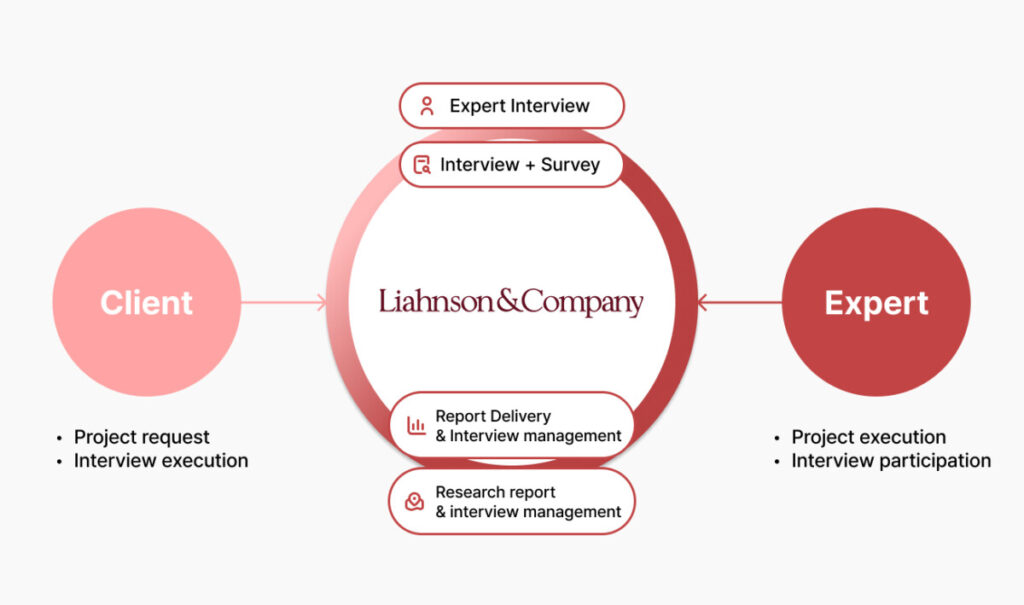
When industry experience becomes essential to answering the remaining questions, expert interviews can play an important role. Expert interviews are a qualitative research method that connects companies with people who have direct experience in a particular industry, company or function, allowing them to explore market context that is difficult to capture through public information alone. Expert Network Services, or ENS, help identify and connect these experts based on the specific requirements of a research project.
For South Korea industry research, it is especially important to find someone who can answer the exact business question rather than simply someone with a broadly relevant industry background. An R&D professional and a procurement manager at the same manufacturing company may have very different perspectives on the market, while experience in product development, sales or supply-chain management can lead to very different insights even within the same organization. When the goal is to understand competitive positioning, supplier-selection criteria, distribution structures or market-entry barriers, the quality of the research depends heavily on whether the interviewee has direct experience with those issues.
Liahnson & Company is particularly well positioned for this type of research in South Korea. Leveraging Remember’s professional data, Liahnson & Company can access a domestic database of more than 6 million professionals and identify experts by industry, company, function, career background and other project-specific criteria. Rather than limiting recruitment to a fixed pool of pre-registered experts, the team can search for candidates based on the specific questions a project needs to answer, which is particularly valuable when the research requires a deep understanding of the South Korean market.
Liahnson & Company’s expert interviews are especially suited to qualitative South Korea industry research rather than large-scale quantitative measurement. They are useful when the objective is to understand why a market behaves in a certain way, how decisions are actually made, or where the reality on the ground differs from what public information suggests. This can include assessing the attractiveness of a new business opportunity, understanding the real competitive landscape, exploring B2B purchasing processes, reviewing distribution structures or validating technical and operational assumptions with people who have direct industry experience.
Combining AI and Human Expertise for More Effective Industry Research
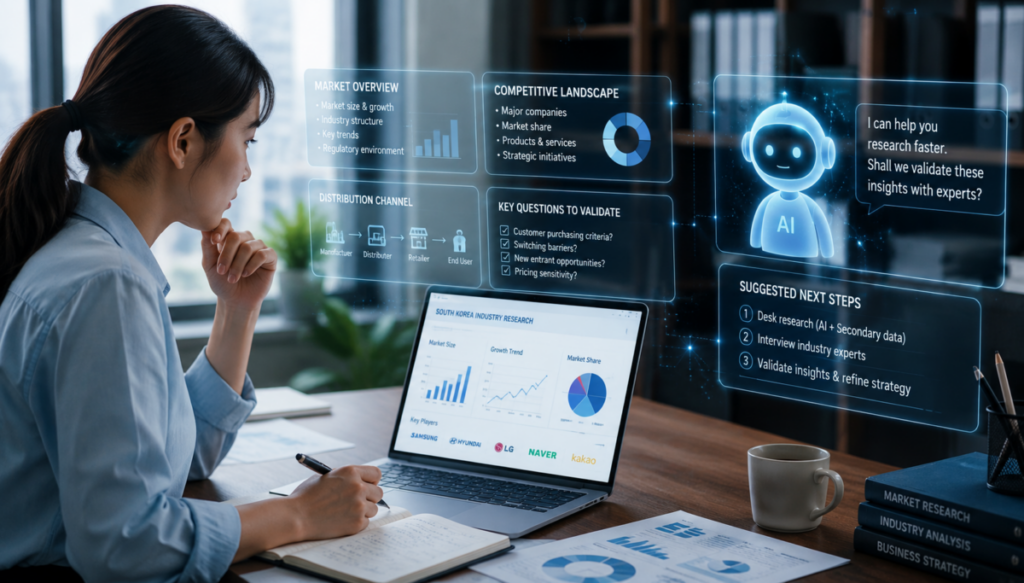
Using expert interviews does not mean reducing the role of AI. In fact, South Korea industry research can become much more efficient when AI and human expertise are used for the areas where each provides the most value. At the beginning of the research process, AI can help you quickly understand key industry terminology and market structures, identify relevant companies and sources and organize the questions that need further investigation. Compared with reviewing every source manually from the outset, this can significantly reduce the time required to define the scope of the research and develop initial hypotheses.
However, AI-generated findings should not automatically become the final conclusion. Important figures should be traced back to their original sources, and when different sources provide conflicting information, it is worth understanding why those differences exist. As the research progresses, questions that cannot be answered confidently through public information can be separated into hypotheses for further validation. Questions that depend on actual market experience can then be tested with customers, industry practitioners or relevant experts.
Effective South Korea industry research therefore does not require choosing between AI and human research. A more practical approach is to use AI to explore the market quickly, verify important facts against reliable primary sources and then validate what cannot be learned from public information with people who have direct market experience. AI can accelerate the research process, while human experience and judgment help determine whether the findings accurately reflect what is happening in the market and whether they are reliable enough to support a business decision.
Ultimately, the quality of industry research is not determined by how many pages have been reviewed. What matters is how much uncertainty has been removed from the original business question and how confidently the remaining assumptions have been tested before a decision is made.
Conclusion
AI has made it faster and easier than ever to begin South Korea industry research, but compiling market size estimates and competitor information alone is rarely enough to assess a real business opportunity. Effective research requires defining the market in the context of your business, understanding the actual competitive landscape and purchasing structure and validating questions that public information cannot answer through direct market experience. This is particularly important in B2B markets, where purchasing criteria, industry practices and barriers to entry are often difficult to understand through desk research alone. Qualitative methods such as expert interviews can provide the context needed to turn market information into more actionable insight. Leveraging Remember’s professional data, Liahnson & Company provides access to a database of more than six million professionals in South Korea and connects companies with experts across specific industries and functions. If your South Korea industry research has reached the point where search alone can no longer provide the answers you need, speaking directly with professionals who have worked in the market can help you validate your assumptions and make the next decision with greater confidence.

Latest Posts
- [Case Study] Connecting Major Korean and Chinese Enterprises for Executive-Level B2B Partnership Discussions
- Black Friday Cybersecurity: Retail Risks and How to Prepare
- Why Saudi Arabia and the UAE Are Betting Big on AI Infrastructure
- How to Find and Connect with Executives in South Korea
- AI Agent Security Governance: What the OpenAI and Google Gemini Incidents Reveal