
Finding senior executives in South Korea can be difficult if you rely only on global contact databases or English-language searches. Depending on your goal, you can identify Korean decision-makers through corporate disclosures, LinkedIn, industry associations, local business events and expert networks. If your goal is to speak directly with an executive or experienced industry professional for research, an expert network can also source and arrange the conversation.
The challenge becomes greater when the person you need is highly specific. Finding the CEO of a major Korean company may be relatively straightforward. Finding a former Head of Procurement who handled a particular product category, an executive who led a specific overseas expansion or a senior professional who worked on a project several years ago is much harder. Even after identifying a name, you still need to confirm what that person actually did, whether their experience matches your objective and whether there is a realistic way to reach them.
This guide explains how to find executives in South Korea, what public information can and cannot tell you, how to assess Korean corporate titles and how to create an actual point of contact with the right decision-maker.
Why Is It Difficult to Find Executives in South Korea?
At first glance, finding Korean executives may seem straightforward. Large companies publish leadership information and listed companies disclose senior management information through corporate filings. News releases and business media also cover executive appointments.
The difficulty is that the person you need is often not the most visible executive.
If you want to understand how an automotive company evaluates new suppliers, simply identifying a senior executive from the company is not enough. You need to know whether that person actually worked in procurement, whether they were responsible for the relevant product category and whether they participated in supplier evaluation or sourcing decisions.
Korean corporate titles can also make executive searches more complicated. Titles do not always translate neatly into English and the same title may represent a different level of seniority depending on the company.
| Korean title | Common English titles used in Korea | What it usually means |
|---|---|---|
| 사원 (Sawon) | Staff / Associate | Entry-level or general staff |
| 주임 (Juim) | Manager / Senior Staff / Senior Associate | A level above entry-level staff in companies that use this rank |
| 대리 (Daeri) | Manager / Assistant Manager | Experienced individual contributor, typically below 과장 |
| 과장 (Gwajang) | Senior Manager | Mid-level rank. Does not necessarily mean the person manages a team |
| 차장 (Chajang) | Senior Manager / Deputy General Manager | Senior rank between 과장 and 부장 |
| 부장 (Bujang) | General Manager / Department Manager | Senior non-executive rank, often responsible for a department or major function |
| 팀장 (Timjang) | Team Leader / Team Manager / Head | A role or position rather than a fixed corporate rank |
| 실장 (Siljang) | Head / Director / General Manager | Usually leads an office or function. Seniority varies significantly by company |
| 본부장 (Bonbujang) | Head of Division / Division Head / Executive Director | Leads a larger business unit or division. May or may not be an executive |
| 이사 (Isa) | Director / Executive Director | Usually an executive-level position |
| 상무 (Sangmu) | Managing Director / Executive Director / Vice President | Executive rank. Official English title varies widely by company |
| 전무 (Jeonmu) | Executive Vice President / Senior Managing Director | Senior executive rank above 상무 |
| 부사장 (Busajang) | Executive Vice President / Senior Vice President | Senior executive below president in the traditional hierarchy |
| 사장 (Sajang) | President | Senior corporate leader. May or may not also be the CEO |
| 대표이사 (Daepyoisa) | Representative Director / CEO | Legally designated representative of the company. Often but not always translated as CEO |
| 회장 (Hoejang) | Chairman | Chairman-level position |
Korean corporate titles do not have exact one-to-one equivalents in English. In fact, the English title printed on a Korean business card is often a company-specific translation rather than a direct indication of authority. For example, Chajang (차장) may appear as Senior Manager at one company and Deputy General Manager at another. A Bujang (부장) may be listed as General Manager, Department Manager or another senior management title.
Roles such as Timjang (팀장), Siljang (실장) and Bonbujang (본부장) require even more caution because they describe the position a person holds within the organization and do not always correspond to one fixed corporate grade. When trying to identify the right decision-maker in South Korea, actual responsibilities, business scope and decision-making authority are therefore more useful than the English title alone.
Current titles can also be misleading. Someone may now work in a different function but may have led the exact business you are interested in several years ago. Another person may have already left the company but may have managed a critical project during the period you want to understand.
When searching for executives in South Korea, it is therefore important to look beyond a current job title and ask when the person held a role, what organization they belonged to and what they actually worked on.

What Public Sources Can and Cannot Tell You
Corporate websites, annual reports, regulatory filings, press releases, business media and LinkedIn are useful starting points. These sources can help you confirm a person’s current employer, official title, previous positions and recent executive appointments. Public interviews or conference appearances may also provide clues about the areas they have worked in.
The limitation is that public sources tend to show titles more clearly than actual responsibilities.
A title does not always reveal the work behind it
Suppose you identify someone who served as Head of Global Business. That title alone does not tell you which markets they covered, whether they personally led a market entry project or whether they were involved in selecting local distributors.
The same applies to procurement roles. A procurement executive may have been responsible for raw materials, electronics, capital equipment or only one business unit. Two people with similar titles may therefore have very different experience.
Historical experience is even harder to trace
A company website reflects its current organization. If you need the person who led a project three to five years ago, that individual may have moved to another division or left the company entirely.
In that situation, you may need to compare past appointment announcements, archived press releases, conference materials, media interviews and individual career histories. For projects tied to a specific product launch, market entry or strategic initiative, the timing of the experience can matter as much as the title itself.
Public information is usually the starting point, not the final answer
Public sources can often help you build an initial list of names. What they cannot easily tell you is whether a person was directly involved in the decision you want to understand, whether they are able to discuss the topic or whether they would be open to a business conversation.
That is why identifying a name and identifying the right decision-maker are two different tasks.

Finding the Right Decision-Maker Beyond a Job Title
When companies search for executives, there is often a tendency to start with seniority. In practice, the right person is usually the one whose experience is closest to the question you are trying to answer.
If you want to understand a company’s investment strategy or portfolio decisions, a former executive or member of senior management may be appropriate. If you want to understand supplier selection criteria, a former Head of Procurement or category leader may be far more useful.
The same principle applies across functions. If your question is about factory operations, the person who managed the site may be more relevant than a corporate executive. If you want to understand entry into the US market, a former international business leader who personally worked on that expansion may be more useful than someone with a broader strategy title.
Before selecting a person, it helps to consider three questions:
- What did this person actually do? Did they select suppliers, launch products, enter new markets or manage the relevant customer segment?
- How closely were they involved in the decision? Did they design the strategy, execute it or participate in final decision-making?
- When did they have this experience? Do you need knowledge of the current market or experience from a specific period?
Length of tenure alone is not enough. Someone may have spent 15 years at a company without working on the business you are researching. Another person may have spent only four years there but directly led the initiative you want to understand.
Finding the right decision-maker is therefore not about finding the most senior person. It is about finding the person whose experience is closest to your question.

How an Expert Network Helps You Find and Reach the Right Person
This is where an expert network can become useful.
An expert network connects companies with professionals who have direct experience in a specific industry, company, function or business issue. The word expert does not refer only to academics, CEOs or public figures. It can include a former procurement executive, a business development leader who managed overseas expansion, a factory manager who ran a particular production process or a sales leader who worked directly with a certain customer segment.
The purpose is not simply to provide a list of contacts. An expert network helps define the type of person needed, identify relevant candidates, verify their background and create a workable connection.
A typical process may include:
- Defining the target industry, company, function and experience
- Identifying current or former professionals who match those conditions
- Confirming the person’s actual responsibilities and relevant project experience
- Presenting suitable profiles for review
- Confirming interest and availability
- Arranging the appropriate form of engagement
For example, if you want to understand procurement decision-making at a Korean manufacturer, the search may go beyond simply finding someone who once held a procurement title. The relevant questions may include which products they managed, whether they evaluated new suppliers and when they held that responsibility.
Likewise, if you need a speaker who can explain how Korean beauty brands enter overseas markets, the most relevant candidate may be someone who actually led international expansion and worked directly on overseas retail channel entry.
The value of an expert network is therefore not the number of names it can provide. It is the ability to narrow a broad search into a group of people whose experience genuinely matches what you need.
What Should You Define Before Starting the Search?
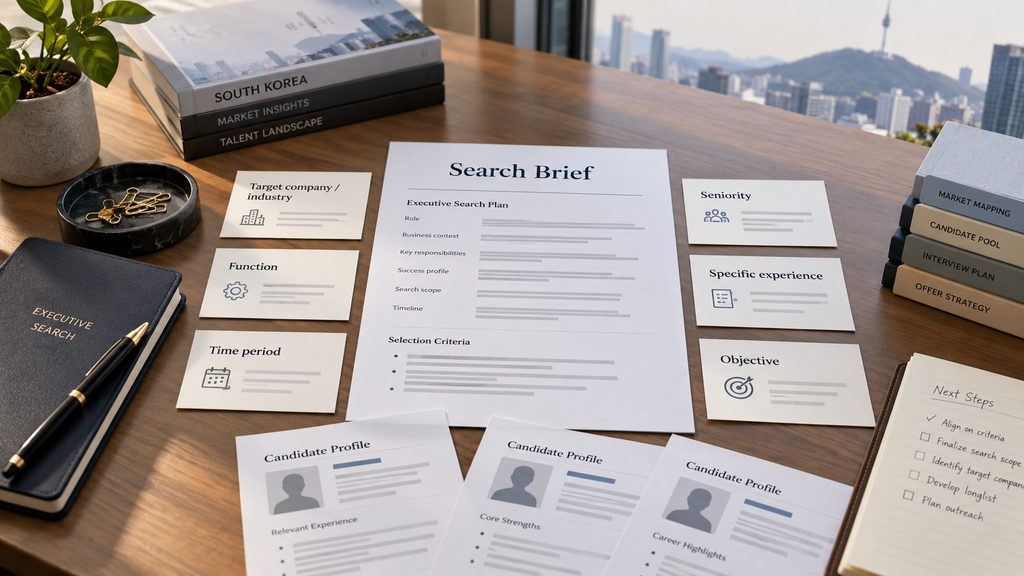
You do not need to know the exact name of the person you want to reach. In many cases, defining the background you need is more useful than starting with a specific individual.
The following information is usually enough to begin:
- Target company or industry: One specific company, several competitors or the industry as a whole
- Relevant function: Procurement, sales, strategy, production, R&D, marketing or international business
- Relevant time period: Current experience or experience from a particular point in the past
- Preferred seniority: Executive level only or senior functional leaders such as division heads
- Specific experience: Supplier selection, market entry, product launch, overseas expansion or another business process
- What you want to learn or achieve: A specific decision, operating process, customer criterion or strategic question
For example, searching for an executive at a Korean battery company is very broad. Searching for a current or former procurement leader at a Korean battery manufacturer who has evaluated cathode material suppliers within the past five years gives the search much more direction.
At the same time, it is useful not to over-specify every condition at the beginning. Requiring one exact company, one exact title and one exact period can exclude candidates whose experience is highly relevant but does not match every label perfectly.
A practical approach is to separate must-have criteria from nice-to-have criteria. This makes it easier to find candidates who genuinely fit the objective rather than simply matching a title.
Once You Have the Right Contact, There Are Many Ways to Work Together
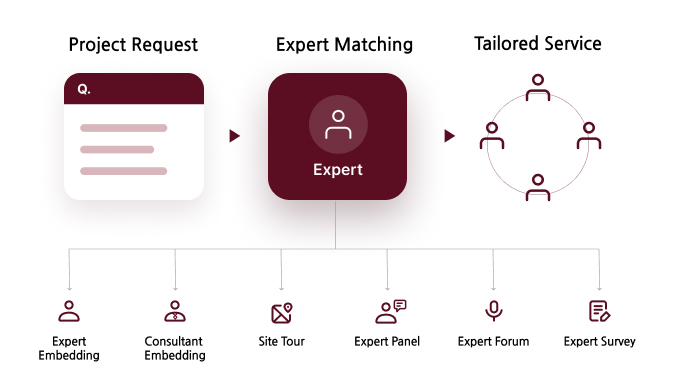
Connecting with the right executive or industry professional can support many different business needs. The best format depends on what you are trying to accomplish.
| Objective | Possible format |
|---|---|
| Understand a specific company or business experience in depth | One-to-one expert interview |
| Bring industry experience into an internal or client event | Executive speaker |
| Compare perspectives from several companies | Executive roundtable or panel discussion |
| Collect views from a selected group of professionals | Expert survey |
| Evaluate a product or business concept | Expert evaluation session |
| Understand operations on site | Expert-supported site visit |
| Add industry expertise to a project for a defined period | Expert or consultant embedding |
If you connect with a former procurement executive, for example, you might speak with them one-on-one about supplier evaluation criteria. A former international business executive may be a strong speaker for a leadership seminar. If you connect with several senior professionals from different companies, they can be brought together for a roundtable around one common business question.
The same network can also support broader formats. A group of selected professionals can be surveyed first, then a smaller number can be invited for deeper follow-up conversations. Product concepts can be reviewed by experienced industry practitioners. An operations expert can join a site visit to help assess production, quality or logistics.
The important point is that the contact itself is only the beginning. Once the right person is identified, the format can be designed around the business objective.
How Liahnson & Company Creates Contact Points with Korean Executives
Finding a highly specific executive in South Korea requires more than knowing how to search. The more detailed the criteria become, the more important it is to understand Korean companies, Korean career structures and the way titles and responsibilities are recorded locally.
Liahnson & Company is a subsidiary of Remember & Company, which built its business network from a business card management service in South Korea. Remember has built a database of more than 6 million business professionals and Liahnson & Company uses this foundation to identify current and former professionals across Korean companies and industries.
This becomes especially useful when the search is highly specific. For example:
- A former executive who managed a particular business at a specific Korean company
- A senior procurement leader with experience evaluating suppliers for a certain product category
- An executive who led international sales or business development at a Korean B2B company
- A professional with long-term experience in a small or highly specialized Korean industry
- Someone who worked in a particular division during a specific period
Liahnson & Company does not rely only on company name and title. Candidate profiles are reviewed against the experience required for the project. The goal is to understand whether the person actually worked on the relevant business, function or decision rather than simply whether they held a similar title.
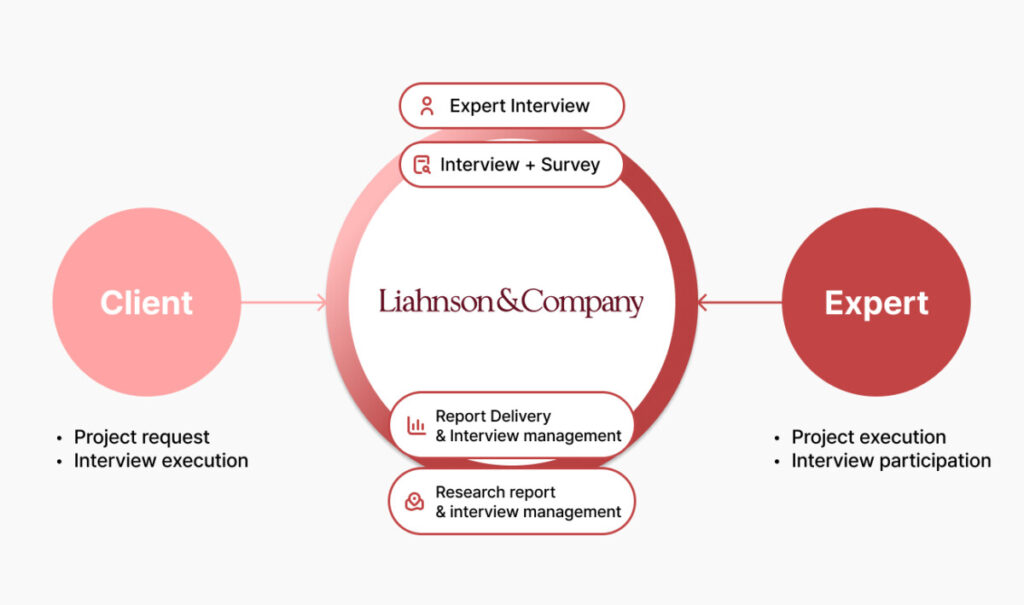
Once suitable candidates are identified, Liahnson & Company confirms their availability and presents relevant profiles to the client. The connection can then be structured according to the objective, from a one-to-one conversation to a speaker engagement, executive roundtable, expert survey or another format.
Liahnson & Company also supports services beyond expert interviews, including expert placement, consultant embedding, site tours, expert evaluation sessions, surveys and forums.
For companies outside South Korea, this local foundation becomes particularly important when global databases or English-language searches do not provide enough detail. Korean titles, historical roles, niche industries and past company experience can all make a seemingly simple executive search much more difficult.
Liahnson & Company combines Korea-focused business data with experience in sourcing local professionals, helping clients move from a broad description of the person they need to an actual point of contact.
The Goal Is Not Just to Find a Name. It Is to Reach the Right Person.
Finding a CEO or a well-known executive in South Korea may be relatively straightforward. Finding the person who made the decision you are trying to understand is often much harder.
The most useful contact may be a former executive who led a business several years ago, a division head who personally managed a supplier decision or a senior industry professional whose name rarely appears in English-language search results.
That is why the process should start with experience, not only with title.
If you are looking to find executives in South Korea, start by defining the company or industry, the function, the relevant period and the type of experience you need. From there, the search becomes much more precise.
If you need help identifying and reaching current or former executives, senior industry professionals, speakers or roundtable participants in South Korea, Liahnson & Company can help build the right connection using its Korea-focused business network and expert sourcing experience.

Latest Posts
- [Case Study] Connecting Major Korean and Chinese Enterprises for Executive-Level B2B Partnership Discussions
- Black Friday Cybersecurity: Retail Risks and How to Prepare
- Why Saudi Arabia and the UAE Are Betting Big on AI Infrastructure
- How to Find and Connect with Executives in South Korea
- AI Agent Security Governance: What the OpenAI and Google Gemini Incidents Reveal