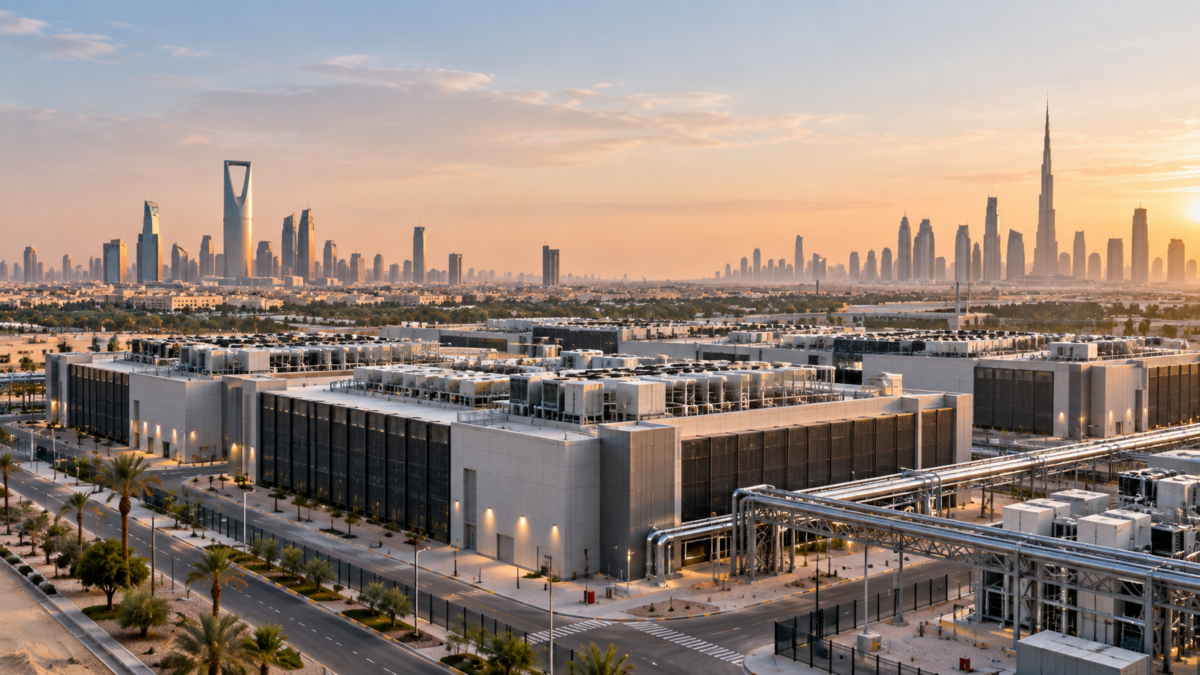
The focus of the generative AI race is changing. In the early days, attention centered on who could build the most capable AI models. Today, the competition has expanded to include the GPUs, data centers, power, cooling systems and networks needed to train those models and run them at scale. As AI models become larger and usage grows, so does the amount of computing power required to support them.
That shift is bringing Saudi Arabia and the United Arab Emirates into the spotlight. Both countries are moving beyond investing oil and gas wealth in global technology companies. They are now building large-scale AI data centers at home while securing advanced GPUs and cloud infrastructure. As the Middle East’s capital, energy resources and infrastructure development capabilities come together with US expertise in semiconductors, cloud computing and AI, a new center of gravity is beginning to emerge in the global AI infrastructure market.
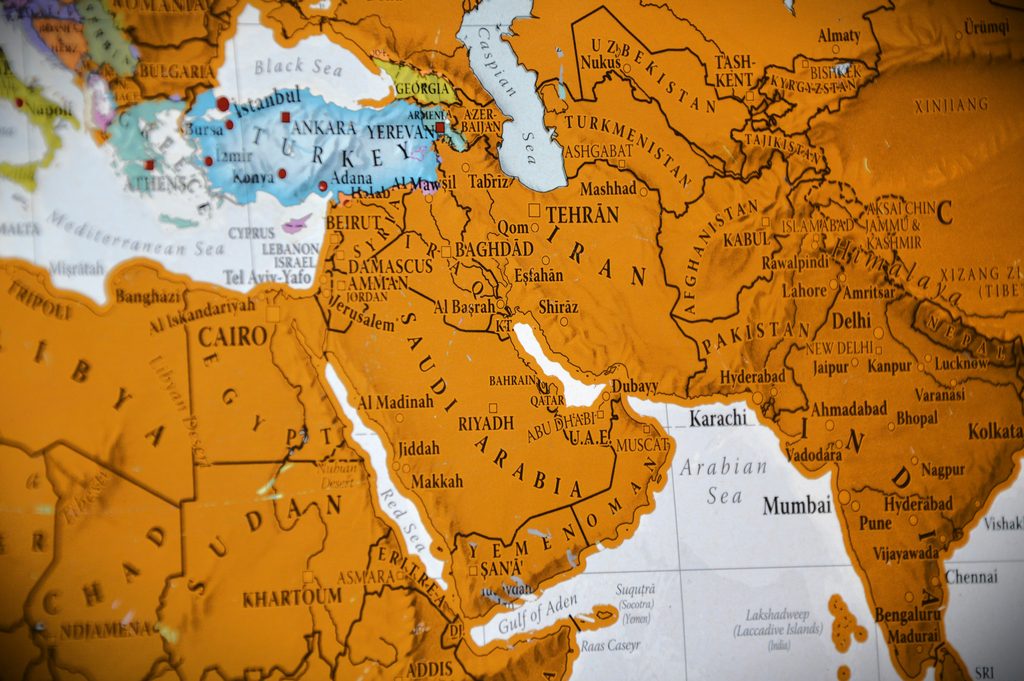
The Middle East Is Becoming a New Front in the AI Race
AI infrastructure means much more than a data center building. Training and running AI models requires GPUs and servers as well as cloud infrastructure, high-speed networks, power supply and cooling systems. As the use of generative AI grows, companies need more than strong models. They also need enough computing capacity to serve large numbers of users at the same time.
The challenge is that securing more GPUs alone does not solve the problem. Those GPUs need somewhere to be installed. Even after a data center is built, it cannot operate at full scale without sufficient power generation and grid connections. AI competition is therefore expanding beyond software into a race for capital, energy and physical infrastructure.
This is where Saudi Arabia and the UAE have some clear advantages. Both countries have large pools of sovereign capital, strong energy sectors and the ability to support long-term infrastructure projects at a national level. Global AI companies bring a different set of strengths, including advanced GPUs, AI models, cloud technologies and access to customers around the world. In many ways, each side has something the other increasingly needs.
The Middle East is also aiming for more than becoming a large market for AI services. Saudi Arabia and the UAE want the computing infrastructure that allows global AI companies to train models and run inference to be located within their own borders. As the AI race expands from building better models to securing the infrastructure needed to run them, the region’s capital and energy resources are taking on a very different kind of value.
Saudi Arabia Wants to Build the AI Industry at Home
Saudi Arabia is building its own foundations to make AI a new growth industry. At the center of that effort is HUMAIN, an AI company established by the Public Investment Fund, or PIF, in May 2025. HUMAIN operates across a broad range of the AI industry, from data centers and high-performance computing infrastructure to cloud services, AI models and enterprise solutions. The reason Saudi Arabia created a dedicated company like HUMAIN is fairly clear. Rather than relying only on AI technologies developed overseas, it wants to build the infrastructure needed to develop and operate AI within the country itself.
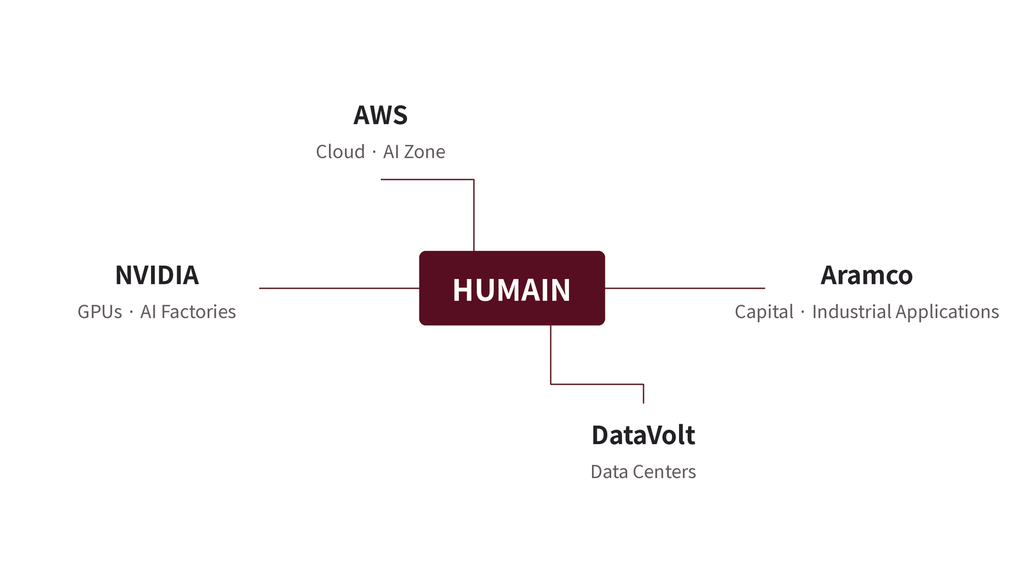
Global companies gathering around HUMAIN
| Partner | Key initiative |
|---|---|
| NVIDIA | Up to 500MW of AI factory capacity planned over five years |
| AWS | More than $5 billion in joint investment for a Saudi AI Zone |
| DataVolt | First-phase data center of around 100MW planned in Oxagon, NEOM |
One of the most significant partnerships is with NVIDIA. HUMAIN plans to develop up to 500MW of AI factory capacity over the next five years and deploy hundreds of thousands of NVIDIA’s latest GPUs in stages. The first phase alone is set to include an AI supercomputer powered by 18,000 GB300 Grace Blackwell GPUs. The goal is not simply to purchase a large number of GPUs. Saudi Arabia is trying to secure enough computing capacity inside the country to train and operate large AI models at scale.
The partnership with AWS goes a step further. The two companies plan to invest more than $5 billion in an AI Zone in Saudi Arabia. Along with AI servers, advanced chips and networking infrastructure for large-scale training and inference, the project will include AWS cloud and AI services that companies can use to build and run their own applications. In 2026, HUMAIN and DataVolt also announced plans to develop an initial data center of around 100MW in Oxagon, NEOM’s industrial city. Partnerships that began with global technology companies are now moving into physical infrastructure development.
Saudi Aramco is also playing a role. In 2026, Aramco contributed around SAR 9.9 billion, or $2.6 billion, in cash to HUMAIN and transferred key AI assets to the company. The participation of one of the world’s largest energy companies is significant because it connects Saudi Arabia’s long-established energy capabilities with its ambitions in AI infrastructure.
Ultimately, Saudi Arabia is not trying to build just a few data centers or a single AI company. It wants a domestic ecosystem that connects computing infrastructure → cloud services → AI models → enterprise applications and turns that ecosystem into a new source of growth beyond oil.
The UAE Wants to Become a Hub Connecting Global AI Companies and Capital
The UAE is also investing heavily in AI infrastructure, but its approach is slightly different. While Saudi Arabia is focused on building more of the AI industry at home through HUMAIN, the UAE is pursuing two strategies at once: building world-class AI infrastructure domestically and investing directly in AI companies and data center assets overseas.
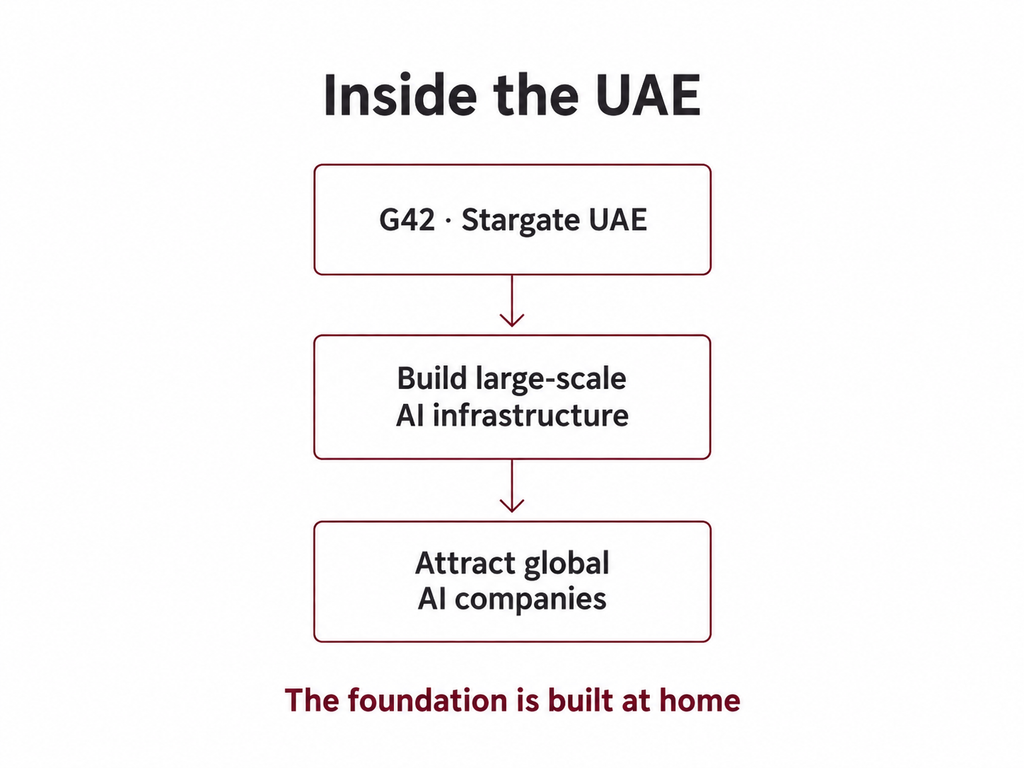
Inside the UAE: Stargate UAE and G42
One of the clearest examples is Stargate UAE. Led by OpenAI and UAE-based AI company G42, the project is designed to build a large-scale AI data center in Abu Dhabi. Training AI models and operating AI services requires huge numbers of GPUs and servers, so the goal is to bring that computing capacity together in the UAE and make it available to global AI companies.
When the project was announced in 2025, Stargate UAE was planned as a 1GW facility with the first 200MW expected to come online in 2026. OpenAI and G42 are joined by Oracle, NVIDIA, Cisco and SoftBank. As of October 2026, however, the first 200MW facility has not yet begun commercial operation.
The project matters because the UAE is trying to become more than a market that simply uses AI services developed elsewhere. Stargate UAE was originally designed as a core component of the much larger 5GW UAE-US AI Campus. The idea is to build an environment where global AI companies can develop and operate AI directly from the UAE. In 2026, however, regional security concerns prompted the country to consider spreading some of the planned infrastructure across multiple locations rather than concentrating everything at a single site.
At the center of this push is G42, which plays a key role in connecting the UAE with global technology companies. Microsoft invested $1.5 billion in G42 and the two companies are also working together on additional data center capacity. Through G42, the UAE is bringing companies such as OpenAI and Microsoft into its domestic AI ecosystem and positioning itself not just as a user of AI but as a place where AI can actually be developed and operated.
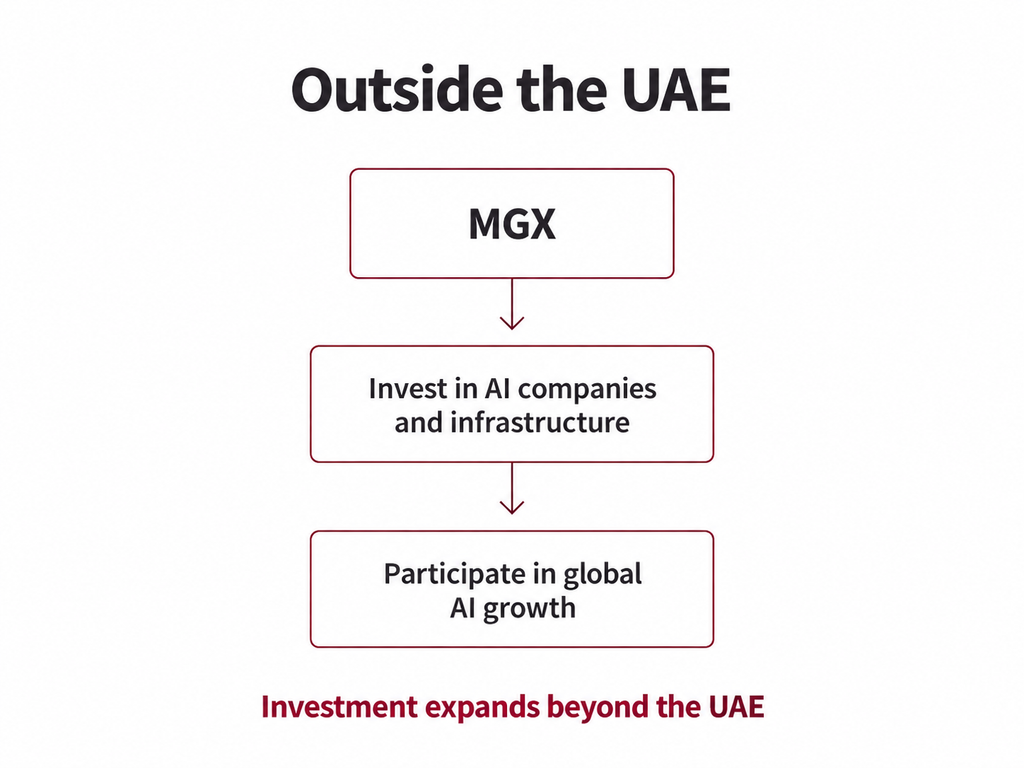
Outside the UAE: MGX
The UAE’s AI strategy does not stop at building data centers at home. It is also investing directly in AI companies and infrastructure overseas through MGX, an Abu Dhabi-based AI investment company. MGX was created to invest across the AI ecosystem, from semiconductors and data centers to AI models and software companies. While G42 is helping build AI infrastructure inside the UAE, MGX is putting UAE capital directly into the global AI industry. Around 70% of its current investments are allocated to North America.
The scale of those investments is growing quickly. In July 2026, MGX closed its first fund at $49 billion, above its original $45 billion target. It has invested in major AI companies including OpenAI, Anthropic and xAI. Its scope has also expanded beyond AI developers into the physical infrastructure needed to run AI. In the same month, MGX joined BlackRock’s Global Infrastructure Partners and others in completing the acquisition of Aligned Data Centers at an enterprise value of around $40 billion. In other words, the UAE is not only investing in the companies building AI but also in the data centers where that AI actually runs.
The strategy is clear. At home, the UAE is building infrastructure that global AI companies can use. Abroad, it is investing directly in those companies and in the data centers that support them. By doing both, the UAE is trying to bring more of the AI industry into the country while also participating in the value created as the global market grows.
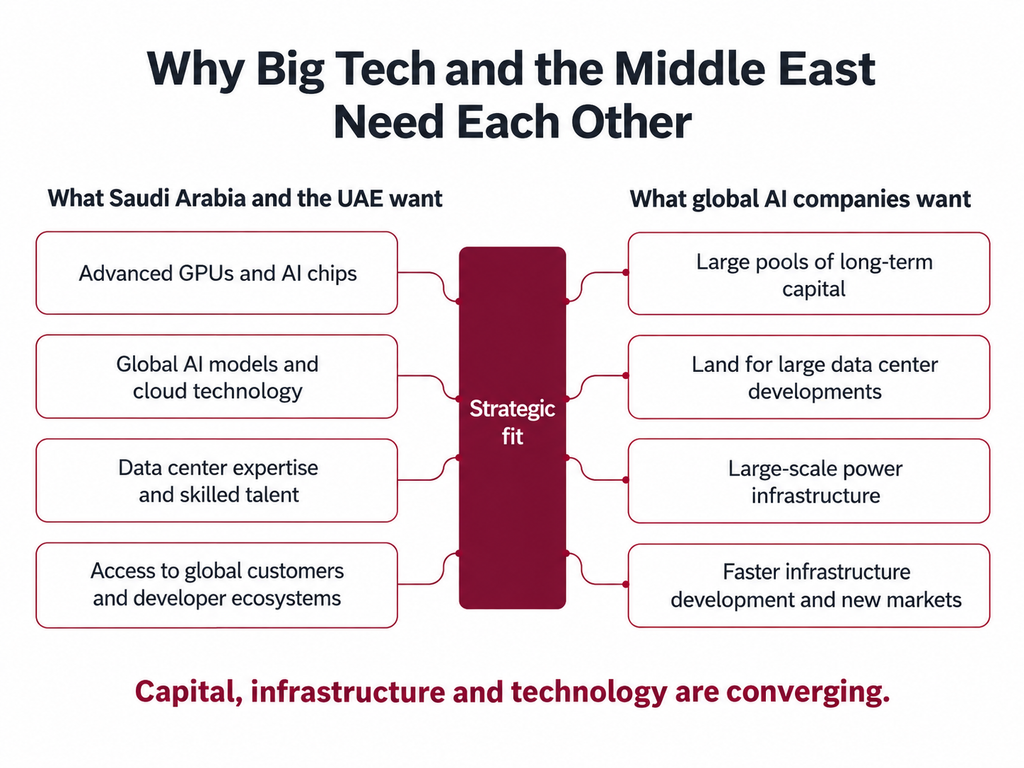
Why Big Tech and the Middle East Need Each Other
The rapid growth of AI investment in Saudi Arabia and the UAE is not happening simply because the Middle East needs American technology. Global AI companies also need enormous amounts of capital, electricity and data center capacity to keep expanding their services. Securing all of those resources quickly is becoming increasingly difficult. That has created a situation where both sides can provide something the other needs.
| What Saudi Arabia and the UAE want | What global AI companies want |
|---|---|
| Advanced GPUs and AI chips | Large pools of long-term capital |
| Global AI models and cloud technology | Land for large data center developments |
| Data center expertise and skilled talent | Large-scale power infrastructure |
| Access to global customers and developer ecosystems | Faster infrastructure development and new markets |
Generative AI requires far more physical infrastructure than a typical software business. After securing GPUs, companies still need data centers to house them along with large amounts of power, cooling systems and high-speed networks. As facilities grow from hundreds of megawatts to gigawatt scale, it becomes increasingly difficult for a single company to finance and develop everything on its own.
That is why projects such as Stargate UAE and HUMAIN involve several global technology companies at the same time. Middle Eastern countries gain access to semiconductors, cloud platforms and AI operating expertise while technology companies gain capital, local partners and new locations where they can expand infrastructure at scale. The relationship is therefore less about oil-rich countries simply buying US technology and more about countries with capital and infrastructure working with companies that have the technology they need.
Why Energy and Power Matter Again in the AI Era
The Middle East’s AI push is often described as oil money moving into AI. Capital is certainly part of the story, but it does not explain everything. Large AI data centers require thousands of GPUs to operate continuously while cooling systems work around the clock to remove the heat they produce. As data centers grow from hundreds of megawatts to several gigawatts, their electricity requirements rise just as quickly.
That is changing what AI companies have to think about. It is no longer enough to ask how many of the latest GPUs they can secure. They also need to know when they can secure enough power to run those GPUs. A company can own thousands of advanced chips, but they are of little use if data center construction or grid connections are delayed. This is one reason why Saudi Arabia and the UAE’s long experience in developing large-scale energy and infrastructure projects is gaining relevance in the AI industry.
For energy-producing countries, this also creates a different way to use their resources. Historically, the focus was on producing energy and selling it abroad. In the AI era, some of that energy can instead be used domestically to support data centers and converted into AI computing capacity sold as a service. Existing energy resources can therefore become an input into a new high-value industry.
That does not mean the Middle East automatically has ideal conditions for AI data centers. High temperatures can increase cooling costs while water supply and grid capacity also need to be secured. Regional security risks are now affecting decisions about where facilities should be built and how they should be designed. The region’s advantage is therefore less about simply having cheap electricity and more about its ability to commit capital and resources to large-scale energy and power infrastructure over the long term.
The Role of Oil Money Is Changing Too
Sovereign wealth funds in the Middle East have invested in global companies for decades. Funds such as PIF and Mubadala have long put capital into finance, real estate, infrastructure and major international companies. That investment continues in AI, but there is an important difference today. Middle Eastern capital is no longer focused only on buying stakes in promising AI companies. It is increasingly being used to build and own the infrastructure on which the AI industry depends.
The shift can broadly be divided into three areas:
- Investing in AI companies: Direct investments in major developers such as OpenAI and Anthropic
- Investing in AI infrastructure: Expanding into data centers, semiconductors, cloud infrastructure and other assets needed to operate AI
- Building businesses directly: Establishing companies such as HUMAIN to develop and operate AI infrastructure
In Saudi Arabia, PIF created HUMAIN and Aramco later contributed both capital and AI assets. In the UAE, MGX is investing not only in global AI companies but also in large data center platforms such as Aligned Data Centers. The region is therefore investing in the growth of AI companies while also acquiring the physical infrastructure where their services run.
What matters is not simply that oil money is moving into AI. The more important change is that Middle Eastern capital is moving from the role of shareholder to that of infrastructure owner and operator. If that continues, Saudi Arabia and the UAE could move beyond being markets that purchase AI services and become markets that supply capital and computing capacity to the global AI industry.
What Still Stands Between the Middle East and a Global AI Hub
Based on the scale of investment announced so far, Saudi Arabia and the UAE appear determined to become major AI hubs. Whether those plans translate into lasting competitiveness, however, will depend on how much of the proposed infrastructure is actually built and used.
The first question is access to advanced semiconductors. Conditions have improved. The US approved exports of advanced AI chips to companies in Saudi Arabia and the UAE in 2025 and eased some restrictions on advanced technology exports to the UAE in 2026. Even so, the region’s latest AI infrastructure still depends heavily on chips supplied by US companies such as NVIDIA. Changes in US export policy could therefore affect GPU deliveries and data center development schedules.
The second question is whether there will be enough customers to use all that computing capacity. Building a data center and keeping its GPUs busy are two different things. Even if billions of dollars are spent on new capacity, returns will be difficult to achieve without enough global companies and AI services using it. For that reason, actual opening dates and long-term customer contracts may ultimately matter more than headline figures measured in MW or GW.
Geopolitical risk is another factor. The UAE’s decision to consider distributing parts of its planned 5GW AI infrastructure across multiple locations reflects the growing importance of physical security. As AI data centers become larger and more strategically important, questions about where facilities are located and how they are protected from disruption become part of the investment decision.
The final challenge is talent and the broader industrial ecosystem. With enough capital, GPUs can be purchased and data centers can be built relatively quickly. Building a deep pool of AI researchers, cloud engineers, semiconductor specialists and experts in power and cooling takes much longer. The same is true for companies that can turn that infrastructure into commercial AI products. For the Middle East to become a long-term AI hub, the businesses and people using the infrastructure will need to grow alongside the facilities themselves.
That means the next stage of the Middle East’s AI story will be measured less by announced investment or planned data center capacity and more by actual GPU deployments, opening dates, secured power supply, long-term customer contracts, utilization rates and the growth of local AI companies.
What Saudi Arabia and the UAE’s AI Push Really Means
It is easy to describe Saudi Arabia and the UAE’s AI investments as another attempt to find the next growth industry after oil. That explanation, however, misses much of what is changing. Saudi Arabia is using HUMAIN to build a domestic ecosystem that connects data centers, cloud services, AI models and applications. The UAE is taking a different route, using G42 and Stargate UAE to bring global technology companies into its domestic infrastructure while MGX invests directly in AI companies and data center assets around the world. The approaches differ, but the direction is similar: both countries want to move from using AI to becoming places where AI is developed and operated.
The next question is not how much money they announce but how much of it turns into functioning infrastructure. Data centers need to open, GPUs and power need to be secured and customers need to show up before today’s investment plans become a sustainable industry. As the AI race expands beyond model performance into a broader competition for semiconductors, data centers, power and capital, Saudi Arabia and the UAE offer an important view of where the physical foundations of the global AI industry may be built next.
At Liahnson & Company, we help businesses go beyond public information by connecting them with industry professionals who can share firsthand insight into how markets, technologies and projects are actually developing. For companies looking at fast-moving areas such as AI infrastructure, that perspective can help turn broad market signals into more

Source
https://www.pif.gov.sa/en/news-and-insights/press-releases/2025/hrh-crown-prince-launches-humain-as-global-ai-powerhouse/
https://www.pif.gov.sa/en/our-investments/our-portfolio/humain/
https://nvidianews.nvidia.com/news/humain-and-nvidia-announce-strategic-partnership-to-build-ai-factories-of-the-future-in-saudi-arabia
https://www.ishgfesfe.humain.ai/en/news/humain-and-aws/
https://www.reuters.com/business/energy/saudi-ai-firms-humain-datavolt-partner-data-center-kingdoms-red-sea-coast-2026-08-31/
https://www.aramco.com/en/what-we-do/energy-innovation/digitalization/building-the-ai-future
https://openai.com/index/introducing-stargate-uae/
https://www.reuters.com/world/middle-east/uae-revises-ai-data-center-plan-after-iranian-attacks-sources-say-2026-09-11/
https://news.microsoft.com/source/2024/04/16/microsoft-invests-1-5-billion-in-abu-dhabis-g42-to-accelerate-ai-development-and-global-expansion/
https://blogs.microsoft.com/on-the-issues/2025/11/03/microsofts-15-2-billion-usd-investment-in-the-uae/
https://www.g42.ai/resources/news/microsoft-and-g42-accelerate-uaes-digital-future-major-data-centre-expansion
https://www.mgx.ae/news-insights/mgx-pleased-confirm-final-close-mgx-fund-i-49-billion-total-commitments-significantly
https://www.mgx.ae/news-insights/aip-mgx-and-blackrocks-gip-close-acquisition-aligned-data-centers
https://www.mgx.ae/news-insights/his-highness-sheikh-tahnoon-bin-zayed-al-nahyan-chairs-mgxs-first-board-meeting-2026
https://www.reuters.com/legal/legalindustry/whats-latest-with-semiconductor-export-controls–pracin-2026-09-23/