
For a long time, online commerce has operated through a familiar process. Consumers search, compare, choose and complete payment on their own. Platforms provide search results and recommendation algorithms, while brands focus on SEO, advertising, product detail pages and review management to stand out in front of consumers.
However, this flow is now beginning to change. AI is no longer limited to recommending related products or answering simple questions. It is starting to interpret user intent, compare products that match specific conditions and in some cases move directly toward purchase. This shift does not simply mean that people will shop through chatbots. More fundamentally, it means that the starting point of commerce is expanding from the search bar to the AI agent.
In this environment, users no longer need to browse every product page themselves. They can simply state their goal, such as “Find a product that matches these conditions” or “Compare suitable options within my budget,” and AI can carry out the process on their behalf.
That is why Agentic Commerce should not be understood as just another UX trend. It is a meaningful shift that may influence how brands are discovered and selected by consumers. Companies may need to move beyond asking what consumers will search for and begin asking how AI can recognize, evaluate and choose their products.
What Is Agentic Commerce?
Agentic commerce refers to a form of commerce in which an AI agent, acting on behalf of a user’s intent, performs part or all of the shopping journey, including product discovery, comparison, recommendation and purchase execution. In traditional commerce, AI has mainly supported recommendations or guidance. In agentic commerce, AI understands the user’s goal and connects that goal to action.
For example, imagine a user asks AI to find a lightweight laptop under 1 million Korean won with long battery life for business trips. In a traditional shopping environment, the user would need to open multiple product pages, compare specifications and reviews and make the final decision on their own. In an agentic commerce environment, AI can organize suitable options, compare strengths and weaknesses and in some cases connect the user directly to purchase.
This is where agentic commerce differs from existing recommendation systems or shopping chatbots.
| Category | Traditional recommendation system | Shopping chatbot | Agentic commerce |
|---|---|---|---|
| Key role | Product exposure and personalized recommendations | Answering questions and providing guidance | Interpreting goals and taking action |
| User role | Browsing and choosing directly | Asking questions and checking answers | Delegating conditions and reviewing results |
| Purchase process | Completed directly by the user | Completed directly by the user | In some environments, AI can lead the process through to purchase execution |
| Essence | Recommendation interface | Conversational interface | Delegated transaction system |
As shown above, traditional shopping chatbots and agentic commerce are different. The key difference is not conversation, but delegation. A chatbot is closer to an interface that provides information, while agentic commerce is closer to a system that performs part of the transaction process based on the user’s intent. In simple terms, it can be understood as agentic AI applied to shopping. This shift goes beyond making shopping more convenient. It may change the way choices are made in commerce itself.
Why Is Agentic Commerce Emerging Now?
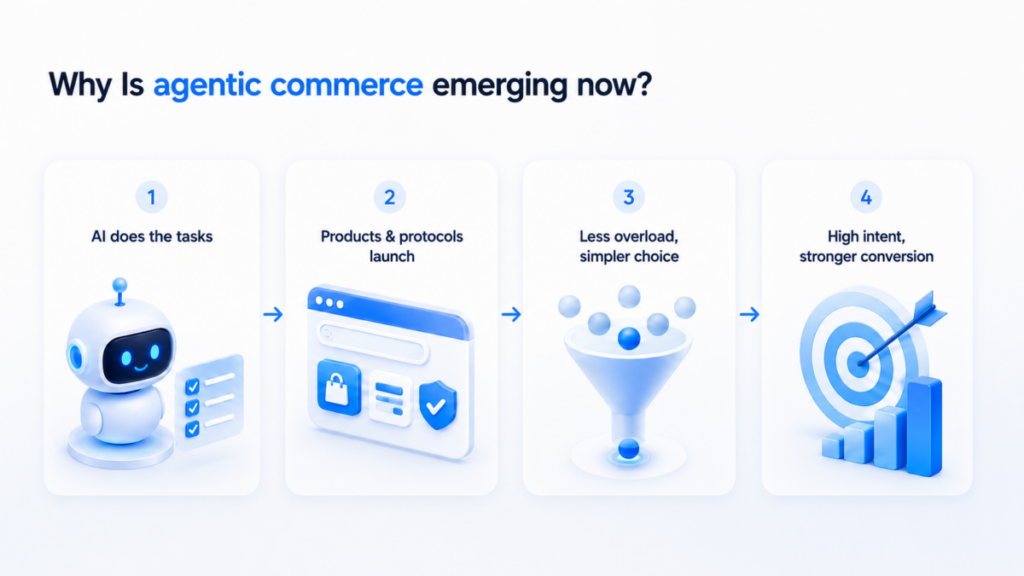
Agentic commerce did not suddenly appear overnight. Rather, it is now becoming a practical reality because several technologies and market conditions have begun to overlap. There are four main factors behind this shift.
First, generative AI has become a tool that can perform tasks on behalf of users
In the early stages, LLMs were mainly used for summarization, translation and writing support. They were tools for organizing information or creating content. Over time, however, users began to delegate more complex and multi step tasks to AI, such as planning travel itineraries, coordinating meetings, drafting documents and comparing products.
Commerce is one of the areas where this shift can be applied most naturally. Shopping is essentially a repeated process of information search, condition comparison and decision making. When a user states what they want, AI can search for products, compare options and organize suitable choices. This flow shows how generative AI is expanding from answering questions to performing tasks.
Second, Big Tech and payment companies are releasing actual products and protocols
OpenAI has introduced a feature that can lead directly to purchases within ChatGPT and has also proposed a protocol for agent based payments with Stripe. Google is also promoting related standards so that AI agents can perform product search and transactions. Amazon is strengthening shopping agents within its own ecosystem.
These developments show that agentic commerce is not just a future prediction. It is already beginning to enter the market. It is not yet universal for all consumers or all retailers, but it is clear that major platforms are starting to design product discovery, payment and transaction standards together.
Third, consumer fatigue is becoming more severe
There are already too many products online. While the number of options has increased, consumer satisfaction has not necessarily increased at the same pace. Instead, there are more factors to compare, more reviews to read and a blurrier boundary between advertising and search results.
Consumers now want less time and better organization, not more information. Agentic commerce responds directly to this fatigue. Users can reduce the effort of searching and comparing every product manually and instead review a curated set of options organized by AI. In this process, the consumer becomes less of a searcher and more of a reviewer.
Fourth, the nature of AI driven traffic is changing
Traditionally, commerce performance has been strongly influenced by both the quality and quantity of search traffic. However, recent industry reports and web traffic analyses suggest that visitors who arrive through AI may show higher conversion rates. This means that AI driven visits may not simply be curiosity traffic, but traffic with stronger purchase intent.
From a commerce perspective, this shift is highly significant. The era ahead may place greater importance on the density of traffic intent than on traffic volume alone. In other words, it may become more important to attract users who arrive with a clear purchasing context than to simply attract a large number of visitors.
How Do AI Agents Choose Products?
When discussing agentic commerce, there is a common assumption that AI agents will make more objective, rational and consistent choices than humans. AI can certainly compare large amounts of information in a short time and organize conditions that users may easily overlook. However, this does not mean that AI choices are always neutral or optimal.
The paper What Is Your AI Agent Buying? Evaluation, Biases, Model Dependence, & Emerging Implications for Agentic E-Commerce illustrates this point. The researchers examined how AI shopping agents select products in a simulated online marketplace. They adjusted factors such as product placement, price, ratings, reviews, advertising indicators and platform recommendation signals to observe how these elements influenced the AI agent’s choices.
According to the study, AI agents can be affected not only by product quality or price, but also by where a product appears on the screen and in what order it is presented. Products with advertising indicators tended to be selected less frequently, while products with platform recommendation signals received more positive responses. Factors that human consumers also value, such as price, ratings and review volume, influenced AI choices as well, but the level of sensitivity varied by model. Importantly, when an AI model is updated, the likelihood of a specific product or brand being selected may also change.
This suggests that in agentic commerce, an “AI selected product” does not necessarily mean the objectively best product. AI compares products based on the user’s conditions, but its choices can also be shaped by information layout, platform signals, data formats and model specific interpretation. In this sense, the agentic commerce market may become less like a fixed optimization environment and more like a dynamic selection market that continues to shift with changes in AI models and platform environments.
This point is also important for brands and retailers. Until now, commerce competition has focused heavily on thumbnails, product detail pages, advertising copy and reviews that encourage people to click. In an agentic commerce environment, however, the information structure that AI can read and interpret becomes just as important as the information people see. Product names, categories, prices, inventory, delivery conditions, return policies, review data and certification information may all influence how AI evaluates a product. Going forward, brands may need to become not only products that people like, but also products that AI can accurately understand.
Global Case 1: OpenAI and Stripe
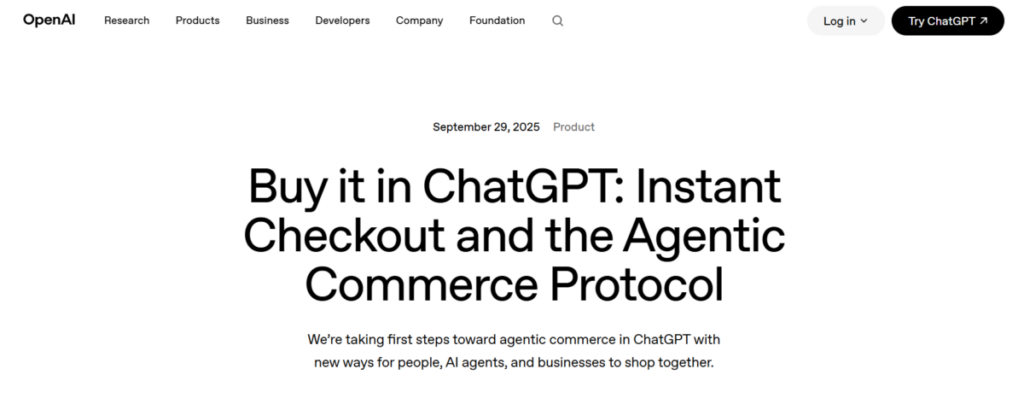
One of the clearest examples of agentic commerce is the collaboration between OpenAI and Stripe. The key point is that ChatGPT does not stop at recommending products. It enables users to discover products they want within a conversation and move directly toward purchase. Instead of going through a search engine, moving to a shopping site and then completing payment, product discovery and purchase are connected within a single conversational experience.
This case matters not only because it makes shopping more convenient. OpenAI has moved the starting point of shopping into conversation, while Stripe provides the payment infrastructure that connects that conversation to an actual transaction. When a user describes the product they want in ChatGPT, Stripe supports the process so that the purchase can be completed. This collaboration shows that AI is not simply helping people shop. It suggests that AI can become a new interface for commerce itself.
Let’s take a closer look at how the transaction process works.

- The user enters the conditions for the desired product in the chat window. The more specific the user is about budget, material, color, style and other details, the higher the chance of finding a suitable product.

- Based on the conditions entered, AI recommends suitable products. The user does not need to search across multiple shopping sites manually. Instead, they can review the product candidates organized by AI, read brief descriptions and select the product they want.
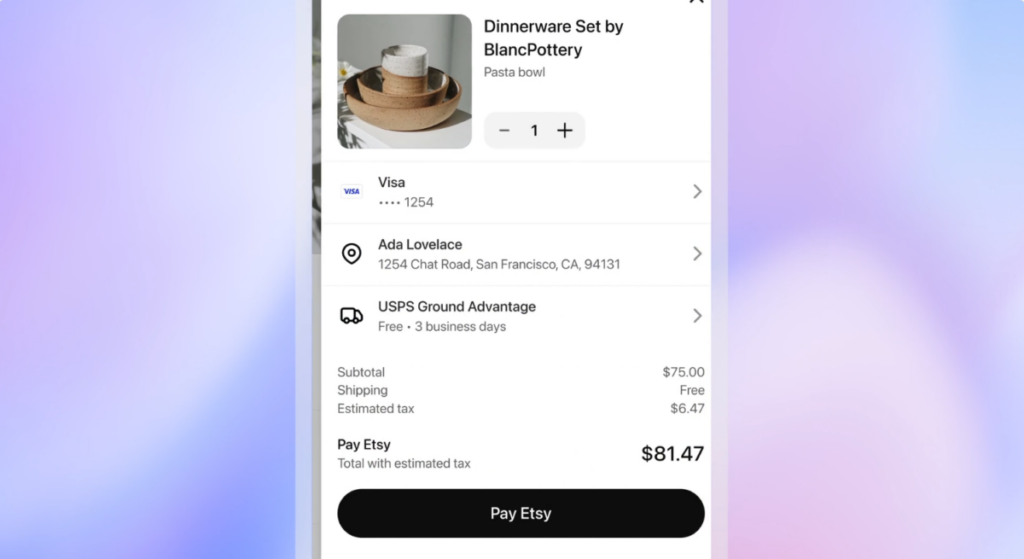
- The selected product moves directly to the payment step within the chat screen, without requiring the user to visit a separate shopping site. The user can review the price, delivery information, payment method and final amount before completing the purchase.

- Once the payment is completed, the user receives a purchase confirmation from the shopping platform where the product is sold.
This feature is known as Instant Checkout in ChatGPT. It is designed to allow users to discover a product inside the conversation and complete payment without moving to an external shopping site. In other words, ChatGPT no longer ends at showing products. It also plays a role in connecting the user’s purchase intent to an actual transaction.
What matters here is that this is not simply the addition of a payment button. When a user explains what they want, ChatGPT interprets those conditions and finds relevant products. Stripe then supports the back end so that the process can lead to payment. In this structure, OpenAI creates the conversational shopping experience, while Stripe provides the payment infrastructure that keeps the experience connected.
This is where Instant Checkout differs clearly from traditional commerce. In a conventional shopping journey, users search for products, move to a shopping site, add items to a cart and then proceed to a checkout page. With this feature, discovery and payment are connected within one flow. Users can complete a purchase with fewer steps, while the platform can complete the transaction within the conversation.
Ultimately, this feature shows that AI can become more than a recommendation tool. It can become a new interface for commerce. As product discovery and payment become part of one connected experience, the starting point of commerce is moving from search to conversation.
Global Case 2: Amazon’s Alexa for Shopping
Another recent example is Amazon’s Alexa for Shopping, introduced in May this year. According to Amazon, the feature is available to customers in the United States through the Amazon Shopping app, website and Echo Show devices. Users can ask shopping related questions directly through Amazon’s main search bar. It is also designed to support a broader set of shopping functions, including product comparison, category summaries, price history checks, price alerts, repeat purchase automation and cart building.

The important point in this case is that Amazon is not treating AI shopping as a separate add on feature. Instead, it is integrating AI into the search bar and device experience, which are core touchpoints of the Amazon shopping journey. While Rufus was closer to an AI shopping assistant that supported product discovery and comparison, Alexa for Shopping is positioned as a broader shopping experience that combines the personalization context of Alexa Plus with Amazon’s shopping data.
This is a highly practical strategy for large retailers. As agentic commerce expands, the first shopping touchpoint for consumers may shift from search engines or shopping mall apps to general purpose AI agents such as ChatGPT, Gemini or Perplexity. In that scenario, platforms like Amazon could lose access to customer purchase intent and discovery data to external AI services. By strengthening its own shopping agent, Amazon is encouraging customers to continue asking questions, comparing options and purchasing within the Amazon ecosystem.
Amazon’s response is therefore more than a feature update. It is a defensive strategy to protect customer touchpoints in the age of agentic commerce, while also shifting from a search centered UX to an action centered UX. Of course, Amazon’s case cannot be applied directly to every retailer. Amazon has extensive product data, purchase history, logistics infrastructure, payment systems and device ecosystems. Still, the direction is clear. Retail competition may expand beyond product selection and fast delivery toward the ability to understand customer intent and connect that intent to purchase behavior.

How Is Agentic Commerce Changing the Structure of Commerce?
Looking across the research and cases above, the essence of agentic commerce is not simply AI shopping. More precisely, it is a reconfiguration of the commerce interface. AI is moving beyond helping consumers shop. It is beginning to redesign the way consumers discover, compare, choose and purchase products.
The core of traditional online commerce has been discovery and conversion. Brands have analyzed the keywords consumers are likely to search for, invested in advertising to appear near the top of search results and managed product detail pages and reviews to encourage clicks and purchases. In other words, competition has centered on being visible to human eyes and making people want to click.
In an agentic commerce environment, this structure may begin to change. If AI agents narrow down the options instead of consumers reviewing every search result themselves, the first challenge for brands is no longer just being exposed to people. It is being included in the AI agent’s candidate set.
This change can appear in three main ways.
| Area of change | Traditional commerce | Agentic commerce |
|---|---|---|
| Discovery method | People search and click | AI interprets intent and organizes candidates |
| Competition criteria | SEO, advertising, reviews and product detail pages | Structured data, trust signals and machine readability |
| Brand challenge | Products that are visible to people | Products that AI can accurately understand and select |
First, discovery structures centered on SEO and advertising may weaken. This does not mean SEO or advertising will disappear. Search engines, shopping platforms and social media will remain important acquisition channels. However, as more consumers ask AI first, more purchases may happen without going through traditional search pages such as Google. In this environment, brands need to think not only about where they appear in search results, but also about what criteria AI uses to recommend their products.
Second, product data becomes more important. AI agents may interpret images and emotional cues to some extent, but in actual recommendation and comparison processes, they rely heavily on structured information. Product names, categories, prices, inventory, delivery dates, return conditions, materials, functions, compatibility, certifications and usage conditions need to be clearly organized. If information is incomplete or inconsistent, AI may struggle to understand the product accurately, which can reduce the chance of being included in the recommended candidate set.
Third, the axis of brand competition may shift. Until now, brands have invested in advertising, content, design and messaging to stay in consumers’ minds. These elements will remain important. However, as agentic commerce expands, brands will also need to compete within AI interpretation structures. In other words, the question will not only be whether consumers know the brand. It will also be whether AI considers the product a trustworthy option.
At this point, what companies need to prepare is not simply the adoption of an AI chatbot. More importantly, they need to refine their commerce data and operating systems. Product information that AI can read, consistent catalog structures, up to date inventory and pricing, clear policy data and reliable reviews and certification information will become increasingly important.
In the age of agentic commerce, brand competitiveness is likely to come from the combination of visible and invisible assets. Companies that can provide attractive brand experiences to consumers while also building a data foundation that AI can understand accurately may be better positioned in the future commerce environment.

What Are the Risks and Limitations?
agentic commerce is clearly an attractive direction. Consumers can make better choices in less time, while companies can connect more quickly with customers who have stronger purchase intent. However, as AI moves closer to the front of the purchase journey, the risks also increase. Because agentic commerce can go beyond recommendations and connect directly to transaction execution, trust and responsibility become even more important.
The first issue to consider is selection bias. If an AI agent favors a certain platform, product arrangement, data format or trust signal, consumers may believe they have compared enough options when in reality they are only seeing a limited set of candidates. The study mentioned earlier also found that AI agents can respond sensitively to product placement, advertising indicators and platform recommendation signals. This suggests that agentic commerce may create new forms of selection bias rather than guarantee more objective shopping.
The second issue is explainability. If users cannot understand why a particular product was recommended, their trust in the recommendation may decline. In agentic commerce, this issue becomes even more important because AI does not simply show products. It can narrow down candidates, compare options and support purchase execution. Users need to understand what criteria AI used to select products, which products were excluded and whether advertising or partnerships influenced the result.
The third issue is accountability. If a user purchases a product based on an AI agent’s recommendation and the result falls short of expectations, who is responsible? It may not be clear whether the issue came from an AI model that misinterpreted the user’s request, a seller that provided inaccurate product information or a platform that processed the payment and order. The boundaries of responsibility become even more complex when automated or recurring purchases are involved.
The fourth issue is payment security and data privacy. For agentic commerce to work properly, AI agents may need access to sensitive information such as user preferences, budgets, purchase history, shipping addresses and payment methods. The more personalized the experience becomes, the greater the concern around security incidents and data misuse. In structures connected to actual payment, authentication, permission management and transaction approval processes become especially important.
Finally, there is also the risk of market concentration. agentic commerce can provide consumers with more choices, but if AI agents are deeply connected only to a few major platforms, payment infrastructures or data providers, market power may become more concentrated. Therefore, when assessing agentic commerce, companies need to look beyond convenience and efficiency. They also need to consider what data is being used, what criteria determine product selection, how much control users have and who is responsible when a problem occurs. Ultimately, the success of this market will depend not only on the sophistication of the technology, but also on whether consumers feel enough trust to delegate purchasing decisions to AI.
Conclusion
agentic commerce is still in its early stages, but it is already entering the strategies of major platforms, payment infrastructure providers and retail companies. OpenAI and Stripe have shown how purchases can take place within conversational AI, while Amazon is strengthening its own shopping agent to keep customer touchpoints within its ecosystem.
The core of this shift is not simply that AI makes shopping more convenient. Part of the process that consumers once handled directly, such as searching and comparing, is moving to AI. At the same time, the criteria by which brands are selected are expanding from human clicks to AI driven judgment. Companies will need to provide attractive brand experiences for consumers while also building product information that AI can accurately understand and trust. The key question in the age of agentic commerce is this. Is our product not only attractive to people, but also selectable by AI?
If you would like to understand how agentic commerce is changing the market or how it may apply to your business in practice, you can speak directly with experts in the field. Share the business challenge you are facing, and we will help connect you with professionals who have hands on experience at leading companies in the relevant area, so you can gain more accurate and practical insights.

Source
https://papers.ssrn.com/sol3/papers.cfm?abstract_id=5381574
https://www.axios.com/2026/05/13/amazon-alexa-ai-shopping-assistant