
Most companies preparing to expand internationally share a familiar experience. The market size data is in hand. A list of competitors has been assembled. The steps for setting up a local entity have been researched. And yet, when it’s time to actually move, something feels incomplete. The numbers look right, but the path in isn’t clear.
That gap is what global market research is supposed to close. Not the act of gathering data, but the full process of determining where a company can realistically compete, how it should enter, and whether the timing makes sense. This article covers what global market research actually involves, the methods companies use to conduct it, where things most commonly go wrong, and what a smarter approach looks like in practice.

What Is Global Market Research?
Global market research encompasses all the activities a company undertakes to systematically collect and analyze information about a target international market and make better strategic decisions as a result. The question it’s trying to answer isn’t just “which country has potential?” It’s “can our company actually capture that potential, and how?” That distinction shapes everything downstream.
The scope is broader than most teams expect when they start. Market size and growth rates are the obvious inputs, but the picture isn’t complete without understanding local consumer behavior, how distribution actually works, who the real competitors are and why they hold their position, what the regulatory environment looks like in practice rather than on paper, and the informal norms that govern how business gets done in a given place. McKinsey’s Strategy and Corporate Finance blog stated that “success rests on developing a deep understanding of the target market,” making clear that the outcome of market entry is determined, to a significant degree, by how well a company understands where it’s going before it gets there. In that sense, global market research isn’t preparation for strategy. It is the strategy.
Why It Matters More Than Ever
The importance of global market research has grown considerably over the past few years, for three main reasons.
First, uncertainty has become structural. Supply chain disruptions, currency volatility, geopolitical risk, and tightening regulatory environments are all moving faster than traditional annual research cycles can track. McKinsey’s blog noted that “companies need to thoroughly understand country-level risks and challenges,” emphasizing that the regulatory, political, and economic variables in each target country require ongoing scrutiny, not a one-time review.
Second, local competition has intensified. There was a time when a global brand’s reputation or technical edge could win market share almost by default in a new country. That’s largely no longer the case. Local players have raised their capabilities considerably, and what resonates at home rarely translates directly abroad. Meeting local consumers at the level of their actual preferences and cultural context is now a baseline requirement.
Third, speed has become a competitive asset in itself. The window of opportunity in most markets is narrower than it used to be. Spend six months on research and a competitor may have already entered. The challenge is no longer precision versus speed. It’s figuring out how to achieve both at the same time.
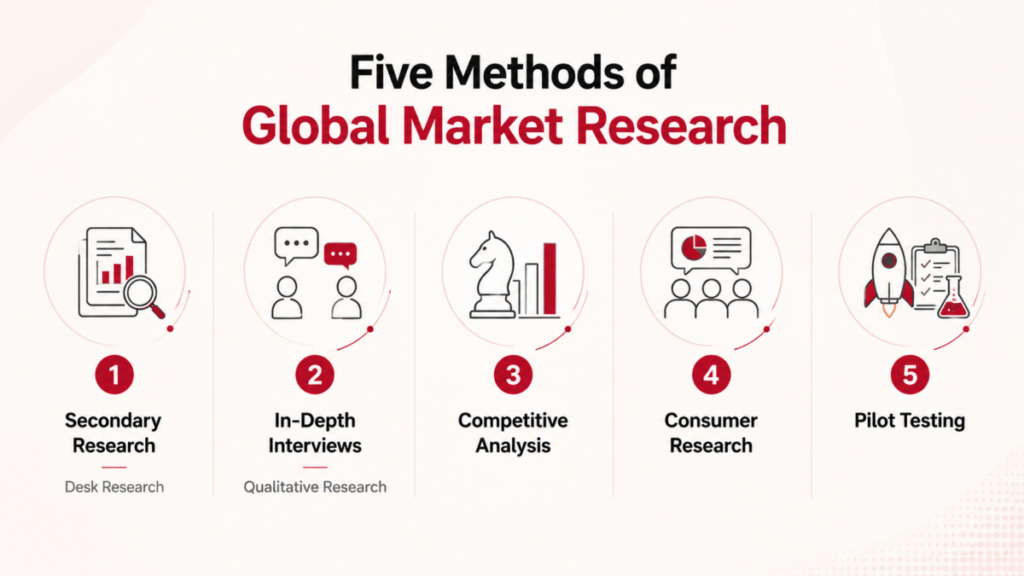
Five Methods of Global Market Research
There’s no single approach to global market research that works in every situation. Most companies draw on a combination of methods, and the returns come from how well those methods complement each other rather than from any one of them in isolation. International markets carry far more information asymmetry than domestic ones, which means the risks of relying on a single source are also higher.
1. Secondary Research (Desk Research)
The most common starting point. Secondary research means collecting and analyzing data that already exists: government statistics, industry reports, trade association databases, academic publications, news coverage. It’s cost-effective and useful for building an initial picture of a market before committing to more resource-intensive methods.
The limitations are real. Secondary data is only as current as its source, and in fast-moving markets, data that’s even one or two years old can already be misleading. Granularity is often insufficient for actual decision-making. Aggregate market size figures are relatively easy to find, but channel-level share within a specific subcategory or purchase frequency by consumer segment rarely are. Secondary research works best as a screening tool and a foundation for designing more targeted research, not as a standalone basis for strategic decisions.
2. In-Depth Interviews (Qualitative Research)
Direct conversations with people who operate inside the target market: potential customers, local partners, distributors, industry specialists, regulatory contacts. Where secondary data tells you what the numbers are, interviews tell you why they are what they are. Cultural nuance, informal decision-making dynamics, and the unwritten rules of an industry simply don’t appear in reports.
In B2B markets especially, a well-conducted interview with the right person often produces more actionable intelligence than weeks of desk research. The practical challenge is access: finding the right people and ensuring the quality of the conversation holds up across language and cultural differences.
3. Competitive Analysis
A structured examination of both local incumbents and global competitors operating in the target market, covering strategy, positioning, pricing, distribution, and go-to-market approach. McKinsey’s blog warned that without a transferable competitive advantage, a new entrant “will simply be competing head on with local players that are more established and have a better understanding of the local context,” stressing that a clear point of differentiation is not optional. Competitive analysis is the work of understanding how those incumbents built their position and where a meaningful opening exists.
Effective competitive analysis goes well beyond mapping who’s doing what. It builds toward scenarios: why they’re doing it, and how they’re likely to respond to a new entrant. That forward-looking dimension is what makes it strategically useful.
4. Consumer Research
Surveys, focus group interviews (FGIs), observational studies, and online panels designed to directly capture the needs, attitudes, and preferences of target consumers. For consumer goods and service companies in particular, consumer research forms the backbone of market entry strategy.
Nielsen’s article “From Theory to Common Practice: Consumer Neuroscience Goes Mainstream” noted that “consumer neuroscience’s much-improved diagnostics capabilities are rapidly making it an essential partner in the creative process,” making the broader point that quantitative metrics alone are insufficient for understanding real consumer response. Behavior and emotional reaction need to be observed alongside the numbers. In international markets, the same stimulus can land entirely differently depending on cultural context, which makes locally calibrated consumer research especially important.
5. Pilot Testing
Launching a product or service at limited scale in the target market, then using the results to refine strategy before a full commitment. Pilot testing is the most direct form of market validation. It confirms or challenges assumptions that no amount of desk research or interviewing can fully resolve.
Bain & Company’s article “Can Marketing Experimentation Become Your Superpower?” noted that “leaders in marketing experimentation often can prove or disprove a hypothesis within weeks,” showing that rapid validation is an achievable standard, not just an aspiration. The same article observed that top-performing companies “orchestrate experiments across the brand portfolio and in most, if not all, markets,” treating pilot testing not as a one-off exercise but as a continuous, institutionalized way of learning.
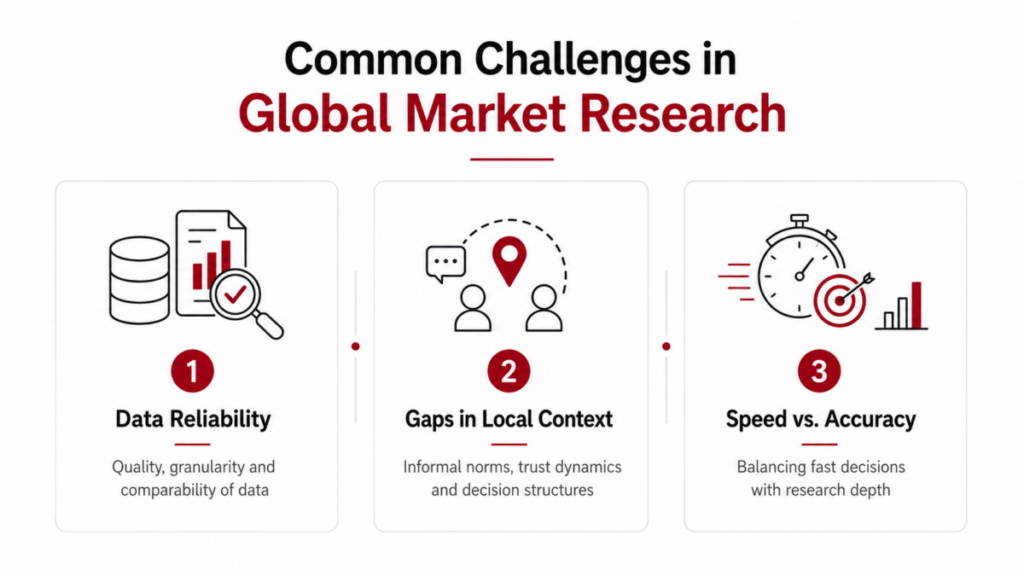
Common Challenges in Global Market Research
Knowing the methods is one thing. Using them well in an unfamiliar market is another. Most companies run into a consistent set of obstacles, and recognizing them in advance leads to better research design.
Data Reliability
The first barrier is data quality. Published statistics and industry reports are abundant, but they rarely reach the level of granularity that real decisions require. And even where data exists, measurement standards differ across countries in ways that aren’t always visible. What counts as “market size” in one country may be calculated on an entirely different basis elsewhere. In many markets, there’s also a structural gap between what official statistics say and how the market actually functions. Treating data at face value, without understanding how it was produced, can be more misleading than having less of it.
Gaps in Local Context
Harder to quantify than data quality, and often more consequential, is local context. Distribution relationships, informal decision-making hierarchies, industry trust dynamics, the unwritten norms around contracts: none of this appears in reports, but all of it can determine whether a market entry works or doesn’t.
Nielsen’s article “Executional ROI Drivers: Optimizing Campaigns to Maximize Returns” stated that “advertisers first need to understand and identify which executional ROI drivers are important for their target region,” pointing out that the same strategy can produce entirely different results depending on local conditions. Missing this layer means having enough data and still getting the strategy wrong.
Speed vs. Accuracy
Thorough research takes time. Markets move faster than research cycles do. This is the most persistent tension in global market research: move fast and you sacrifice depth; take the time to do it properly and you may miss the window.
Bain & Company’s article “Can Marketing Experimentation Become Your Superpower?” cautioned that “the insights generated may be ephemeral because of shifting consumer preferences and underlying seasonality in many markets,” a clear reminder that research findings are not fixed truths. By the time a research engagement concludes and execution begins, the market may have already moved. Solving this requires rethinking how research is designed, not just how fast it runs.

The Structural Limits of Traditional Market Research
The challenges above aren’t just execution failures. Many of them trace back to how conventional global market research is structured, and understanding those limits is what points toward a better approach.
The Report-Centric Model
The default for most companies: commission a consulting firm or research agency, wait several months, receive a detailed document. Reports are good at describing what exists. They’re much less useful at telling a company what to do, and they don’t update when the market does. Bain & Company’s article noted that “we often see organizations view specific channels in isolation,” pointing to a fragmented, item-by-item view of market data that makes it nearly impossible to understand how a market actually works as a whole.
Slow Decision Cycles
From brief to delivery, a serious research engagement often takes months. Large projects can run six months to a year. In that window, competitive dynamics shift, internal decision contexts change, and the business case that motivated the research may no longer look the same. The result is expensive reports that inform discussions rather than decisions, and in some cases don’t get used at all. Research stops driving decisions; decisions end up waiting for research.
Disconnection from Execution
The deepest issue is the gap between research and action. The team that produced the report is not the team that has to operate in the market. Context and judgment that built up during the research process don’t transfer fully into a finished document. The people receiving the report inherit conclusions without the reasoning that produced them. Bain’s article made the point that “experiments should boost measurable performance across the full funnel,” meaning research only creates value when it connects to the full chain of execution. A model where research ends when the report is delivered makes that connection structurally difficult to achieve.
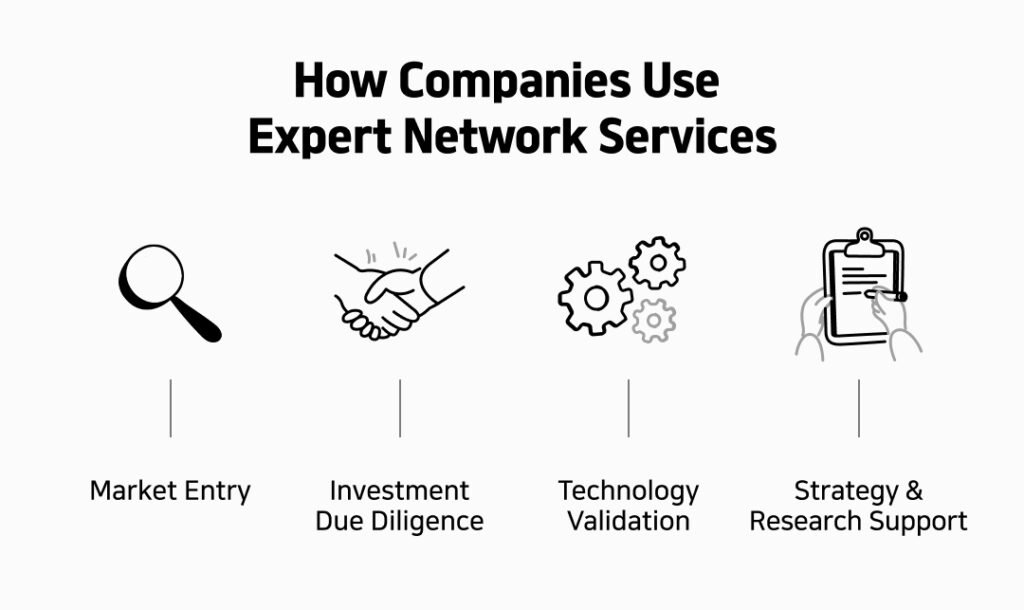
Expert Network-Based Global Market Research
Expert network-based research emerged as a direct response to these structural limitations. The model started in private equity and hedge funds, where investment decisions required fast, specific access to people with direct industry knowledge. It has since expanded into market entry strategy, supply chain due diligence, regulatory mapping, and a range of other applications where speed and specificity matter. Instead of waiting for a report, a company gets direct answers from people who have actually navigated the market in question.
The mechanics are straightforward. A company identifies what it needs to understand and frames the right questions. The expert network then matches them with practitioners who have direct, relevant experience: current or former operators, local industry insiders, category specialists, regulatory professionals. A structured interview, typically 30 to 60 minutes, follows. Compared to traditional research, the practical differences show up in speed (interviews can be arranged within days rather than months), information density (tacit knowledge and execution risk that would never appear in a report surface naturally in conversation), and flexibility (real-time follow-up is possible in a live conversation in a way that a finished document simply cannot allow).
Use Cases
Expert networks are applied across a range of situations in global market research.
- Market Entry Feasibility: Before committing to a specific country, interviews with local practitioners quickly surface the real picture of market accessibility and key risks.
- Competitive Intelligence: Conversations with former executives or close industry observers provide visibility into a competitor’s actual strategic direction and organizational priorities.
- Partnership Due Diligence: Before signing with a local distributor or partner, expert validation of that partner’s reputation and operational capabilities reduces execution risk.
- Regulatory Risk Assessment: Former regulators or compliance specialists provide practical interpretations of regulatory environments that official documentation alone cannot capture.
The quality of an expert network service depends heavily on the depth of its database and how quickly it can surface the right match. Liahnson & Company maintains a database of over 5 million experts in Korea and more than 5.5 million globally, and delivers interview-ready expert profiles within 24 to 72 hours of a request. For companies that need to move quickly without sacrificing the quality of what they learn, that combination matters.

Principles for Effective Global Market Research
Effective global market research isn’t only about which methods you use. It’s about the principles guiding how you approach the work.
Combine Quantitative Data with Expert Insight
The most actionable research integrates both. Data describes what is happening. Expert input explains why, and points toward what to do about it. In international markets especially, the same number can mean something entirely different depending on the local context in which it was produced. That’s why interpretive expertise isn’t a supplement to data. It’s what makes data usable. When the two work together, research findings actually translate into executable strategy.
Build a Fast Validation Structure
The goal isn’t to commission one large, comprehensive research project and act on its conclusions. It’s to design a structure that continuously tests the most critical hypotheses quickly. Combining pilot tests, expert interviews, and small-scale consumer research allows companies to eliminate key risks before significant capital is deployed. A well-designed experimentation structure resolves the tension between speed and accuracy rather than forcing a choice between them.
Keep Research Decision-Centered
The most important principle: research should never become an end in itself. Global market research should begin with the question “what decision do we need to make?” and be designed backward from there. Define what information is needed to make that decision, then choose the most efficient path to get it. A 100-page report is not inherently more valuable than clear answers to five critical questions. The measure of research quality is not how much was gathered, but how directly it informed a decision.
Conclusion: The Paradigm Is Shifting
Global market research is no longer a competition to collect the most data. What matters now is how quickly, accurately, and close to execution a company can read a market. McKinsey’s Strategy and Corporate Finance blog stated that “success rests on developing a deep understanding of the target market,” and that remains true, but what counts as deep understanding has changed. It’s not a thick report. It’s the kind of knowledge that only comes from people who have actually operated in that market, applied at the moment a decision needs to be made.
Expert network-based research is increasingly how companies that take global expansion seriously get there. Direct dialogue with local practitioners, rapid hypothesis validation, and immediate connection to execution: this approach works because it was built around how decisions actually get made, not around how research has traditionally been delivered. Bain & Company’s article noted that “marketing experimentation can become your superpower,” and the same logic applies here. Companies with fast, flexible research structures build market positions more efficiently than those still relying on conventional methods.
Liahnson & Company helps organizations get the qualitative insight they need for global market research, faster and more precisely than conventional approaches allow. The local knowledge, industry dynamics, competitive context, and execution risks that reports miss are exactly what direct expert conversations surface. If you’re preparing for international market entry, or looking for a better approach to market intelligence, Liahnson & Company connects you with the right people to make decisions you can actually act on.

Source
https://www.bain.com/insights/can-marketing-experimentation-become-your-superpower
https://www.nielsen.com/insights/2022/executional-roi-drivers-optimize-campaigns-to-maximize-roi
https://www.nielsen.com/insights/2016/from-theory-to-common-practice-consumer-neuroscience