
AI is now reshaping the cybersecurity landscape. Until recently, AI was mainly seen as a tool that helped security teams detect threats faster, reduce repetitive analysis work and manage vulnerabilities more efficiently. Today, however, the same technology is also becoming a new tool for attackers. With AI, attackers can analyze large volumes of code and system architecture more quickly, identify vulnerabilities that humans may overlook and combine possible attack paths in more sophisticated ways.
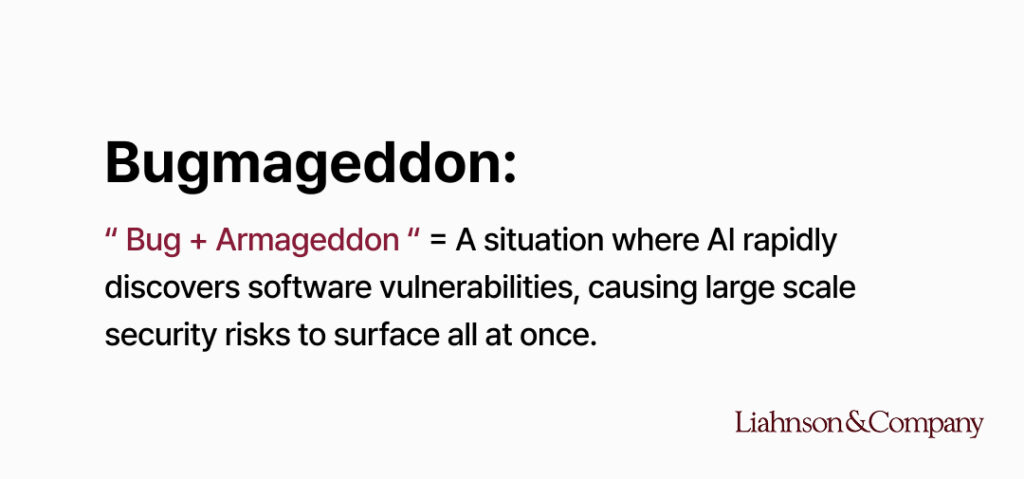
Amid this shift, one term has started to draw attention across the security industry: Bugmageddon. The word combines “bug” and “Armageddon” and refers to a situation where AI rapidly discovers software vulnerabilities at scale, exposing a level of security risk that companies and governments may struggle to handle all at once.
The problem is not simply that AI can find bugs better. The more important issue is that the speed of discovery and the speed of exploitation are both increasing. Attackers can use AI to test many possibilities in a short period of time, while defenders still need to go through complex processes such as approval, testing, deployment and recovery.
As this speed gap grows, cybersecurity risk moves beyond a purely technical issue. It becomes a business risk connected to service disruption, loss of customer trust, regulatory response and operational continuity. So what exactly is Bugmageddon, and how is AI changing the threat structure of cybersecurity? Let’s look at its meaning, major global cases and the response strategies businesses need to prepare.
What Is Bugmageddon?
Bugmageddon is a term that combines ‘bug + Armageddon‘. It refers to a situation where AI rapidly discovers software vulnerabilities, causing large scale security risks to surface all at once. It does not simply mean that there are more bugs. Rather, it describes a world where vulnerabilities are discovered faster and can also be exploited faster.
In the past, when a vulnerability was discovered, security teams had some time to review it, create a patch, test it and deploy it. However, as AI begins to be used for code analysis and attack scenario design, that window of time is shrinking. Attackers can use AI to test many possibilities quickly, while companies still need to go through approval, testing, deployment and recovery processes.
The Key Issue Is the Speed Gap
| Category | Traditional Security Environment | Bugmageddon Era |
|---|---|---|
| Vulnerability discovery | Human led analysis and research | Large scale AI based detection |
| Attack preparation | Requires expert knowledge and time | Accelerated by automation and AI assisted tools |
| Corporate response | Focused on patching, testing and deployment | Requires real time prioritization and faster decisions |
| Scope of risk | Security issue within individual systems | Expands into operational, trust and regulatory risk |
The key point is that AI can be used for defense, but it can also be used for offense. Security teams can use AI to identify vulnerabilities faster and detect threats more efficiently. At the same time, attackers can use AI to analyze code structures, identify authentication bypass possibilities and explore potential attack paths.
Ultimately, Bugmageddon is a management risk that goes beyond a technical threat. A single vulnerability can lead to service disruption, customer data exposure, loss of brand trust and regulatory issues. Companies therefore need to view cybersecurity not simply as an IT management function, but as a core operational strategy for protecting business continuity and customer trust.

Why Did Bugmageddon Become More Serious in 2026?
The reason this issue has become more important in 2026 is that AI is moving beyond security analysis support and beginning to enter real attack campaigns. Google Threat Intelligence Group, GTIG, reported that an AI assisted attempt involving a workable zero day exploit had been identified. In simple terms, this means AI was used in the process of identifying an unfixed vulnerability and turning it into a potential attack tool. Weaknesses that once required human experts a long time to discover can now move toward exploitation much faster with AI.
That is why the cybersecurity threat in 2026 is no longer just about the existence of bugs. It is about a world where a bug can become exploitable almost as soon as it is discovered.
What makes this shift even more concerning is that AI’s vulnerability detection speed is advancing faster than many expected. Anthropic’s latest AI reportedly found more than 100 high risk vulnerabilities in Firefox in just two weeks, a scale comparable to what the global security research community would typically discover over two months. This case shows that AI is no longer just a faster assistant. It is becoming a force that puts pressure on the entire pace of corporate vulnerability management.
As a result, in 2026, the more important question is not simply whether a vulnerability can be discovered. The real question is how quickly it can be blocked after discovery.
In the end, Bugmageddon does not only refer to a sudden flood of bugs. It refers to a situation where AI finds bugs so quickly, and attackers can use them so quickly, that corporate defense systems may fall behind. That is why this issue is no longer limited to development teams. It now requires companies to review the entire software supply chain, security operations and organizational response systems.
Global Case 1. AI and the Prevention of Zero Day Exploitation
One of the most notable cases in the global security industry is Google’s AI security agent Big Sleep. Big Sleep is an LLM based vulnerability detection framework jointly developed by Google DeepMind and Google Project Zero. It is being used to identify previously unknown security flaws in real software. In 2025, Google announced that Big Sleep had discovered a security vulnerability in SQLite, an open source database engine, and helped block it before attackers could exploit it in the real world.
This case is important because it combined Google’s threat intelligence with AI based code analysis. Google detected signals suggesting that attackers were preparing a zero day attack. Big Sleep was then used to narrow down the vulnerability the attackers appeared to be targeting. As a result, the vulnerability was identified and patched before it could lead to real damage.
Google described this case as the first time an AI agent was used to directly foil an attempt to exploit a vulnerability in the wild. However, the key point is not that AI carried out an attack. Rather, AI was used defensively to find the vulnerability before the attacker could exploit it. In other words, Big Sleep was not used as an attack tool. It was used as a defender’s tool, helping prevent potential damage in advance.
This case marks an important turning point in the Bugmageddon discussion. AI is no longer limited to writing phishing emails or assisting with simple coding tasks. It can analyze the structure of real codebases and identify high risk vulnerabilities. At the same time, it also warns us that if the same capability falls into the hands of attackers, the speed of zero day discovery and attack preparation could increase significantly.
The core message from the Big Sleep case is clear. AI can give defenders more time, but it can also increase the speed of attacker discovery. Bugmageddon begins with this race in speed.

Global Case 2. Anthropic Mythos Preview and the Realization of Bugmageddon
The second case involves Anthropic’s high performance AI model Mythos Preview and how it was used in advanced security research. In simple terms, researchers used AI to identify vulnerabilities in a macOS environment protected by Apple’s latest security technology and connect them into a path that could be used for a real attack scenario. This case shows that AI can move beyond simply finding bugs and assist in developing discovered vulnerabilities into attack scenarios. This is one reason why concerns about Bugmageddon are growing across the global security industry.
Palo Alto based security firm Calif disclosed that it used Mythos Preview to implement a kernel memory corruption exploit that worked on Apple M5 based macOS 26.4.1 in just five days. The exploit connected two bugs and several bypass techniques. It started from normal user privileges and could escalate to root privileges. It gained particular attention because it worked in an environment where Apple’s hardware assisted memory safety technology, Memory Integrity Enforcement, MIE, was enabled.
However, it would be an exaggeration to say that “AI alone broke through Apple’s security.” MIE is a defense technology designed by Apple at the hardware and software level to make memory corruption attacks much more difficult. In this case, Mythos Preview helped accelerate bug identification and exploit development, but bypassing MIE still required the judgment and experience of human security experts. Therefore, it is more accurate to view this case not as AI single handedly breaking a security system, but as an example of how much faster advanced security research can become when AI and experts work together.
The key takeaway is that Bugmageddon is not a phenomenon where AI completely replaces human security experts. The more realistic change is that when skilled security experts and AI are combined, advanced vulnerability research and attack path analysis that once took a long time can move much faster. For defenders, this creates an opportunity to find and respond to vulnerabilities sooner. For attackers, it also opens the possibility of analyzing and bypassing existing security systems more quickly.

Key Implications of the Bugmageddon Era
Bugmageddon may sound like a term designed to create fear. However, it should not be dismissed as simple threat marketing. Rather, Bugmageddon is a signal that companies and governments need to change the way they think about cybersecurity.
First, cybersecurity can no longer be treated as a post incident response function. In an era where AI accelerates vulnerability discovery, waiting until a vulnerability is publicly disclosed may already be too late. Companies need to understand their assets in advance, reduce exposed attack paths, set clear patching priorities and automate detection and response where possible.
Second, cybersecurity is no longer only a technical team issue. A single vulnerability can lead to service disruption, customer churn, regulatory risk and loss of brand trust. For leadership teams, cybersecurity should not be viewed simply as a cost. It should be treated as a core condition for business continuity.
Third, AI is both a risk and an opportunity. Attackers can use AI to find vulnerabilities faster and build attack scenarios more efficiently. At the same time, defenders can also use AI to accelerate code analysis, log monitoring, threat intelligence and incident response. The key question is not whether a company should adopt AI, but how it should use AI within the right controls and processes.
Fourth, prioritization becomes more important than speed alone. In the Bugmageddon era, companies may face too many vulnerabilities to fix all at once. This means they need to prioritize based on real exploitability, external exposure, business impact, data sensitivity and recovery difficulty.
What Businesses Should Do Now
1. Reassess Core Assets First
In the Bugmageddon era, companies need to start by knowing exactly what they are trying to protect. Assets that are more likely to be exposed externally, such as servers, cloud environments, VPNs, external APIs and admin consoles, should be reviewed first.
Systems connected to customer data, or systems that could allow an attacker to move deeper into the internal network, should also be treated as higher priority. Rather than trying to review every asset at once, it is more practical to begin with the areas that carry the highest risk.
2. Build a Patch System, Not Just Faster Patching
Many companies talk about patching faster. In reality, however, the patching system itself matters more than speed alone. In an environment where AI enabled attacks become more common, exploitation attempts may begin even before a vulnerability is widely disclosed. Companies therefore need a continuous response system rather than a purely reactive process.
This requires several capabilities.
- A classification process within 24 hours after vulnerability detection
- An emergency patching path for critical assets without unnecessary exceptions
- Standardized policies for virtual patching and temporary blocking
- Automated linkage between testing and production environments
- Alternative controls when vendor patches are delayed
Companies need to review the traditional monthly or quarterly security operation model. More importantly, patching should not depend on one time effort. It should become a repeatable operating process.
3. Automate Detection and Response
Cybersecurity in the AI era cannot rely on a structure where humans read and respond to every alert. Parts of detection, classification, alerting and response need to be automated.
For example, if abnormal traffic is detected, the relevant session can be automatically isolated. If a suspicious file is downloaded, it can be sent to a sandbox for analysis. If signs of authentication bypass appear, the account can be forced through additional verification.
This matters because AI enabled attackers may be able to test validated attack flows in a very short period of time. In this environment, the first 10 minutes of defense can determine the outcome. Tools such as SOC, SIEM, SOAR, EDR and XDR should not simply exist as separate systems. They need to be connected to real response scenarios.
The purpose of automation is not to remove people from security operations. It is to help people focus on higher value decisions. Automation should reduce alert overload, while human experts focus on exception handling, judgment and strategy.
4. Review Supply Chain and Third Party Risk
Bugmageddon is not only about internally developed code. In many cases, vulnerabilities arise from external open source components, management tools, plugins, authentication integrations and cloud configurations. The attack identified by Google was also reported to involve a weakness in an open source based web management platform.
This means supply chain security needs to become a core business priority. Companies should secure SBOMs, review open source update cycles, minimize third party access rights, block unauthorized plugins and evaluate vendor security practices.
In the AI era, the largest attack surface may not be what a company builds directly. It may be what the company imports, integrates and depends on.
Companies should also prepare for situations where external vendors are slow to issue patches. Security SLAs and emergency response clauses should be included in contracts. Supply chain security is no longer just an IT purchasing issue. It is part of enterprise risk management.
5. Practice Crisis Communication
One of the most easily overlooked areas in Bugmageddon is communication. When a real security incident occurs, the biggest confusion often comes not from the technical issue itself, but from decision making and communication. Once systems go down, customers, partners, executives, regulators and the media may all require information at the same time.
Companies therefore need a clear crisis communication plan. They should define who drafts the first notice, who reviews legal language, what level of fact checking is required before public communication, who manages customer compensation and who owns the post incident explanation.
Regular simulations are also important. The goal is to improve decision making speed before a real crisis happens.
In the AI era, incidents can spread faster. Communication needs to move faster as well. In many cases, sharing verified facts early protects trust better than a delayed apology.
6. Use AI Actively for Defense
AI is not only a tool for attackers. It can also be highly valuable for defense, especially in repetitive tasks such as log summarization, anomaly detection, vulnerability classification and threat intelligence analysis.
By using AI in these areas, security teams can spend less time on repetitive work and more time on judgment and response. However, companies should not hand over final decisions entirely to AI. The better approach is to let humans set the standards, while AI helps execute and analyze work faster.
For companies that want to understand how these strategies are applied in real security environments, speaking directly with practitioners can be the fastest path. Expert network services can help companies understand how security teams prioritize risks, which tools are being used in the field and which response measures have proven effective in practice.
Bugmageddon Is Not the Future. It Is Already Here.
Bugmageddon may sound like a provocative new term, but global cybersecurity developments in 2026 show that it is not an exaggeration. AI is finding vulnerabilities faster, attackers are moving more quickly to weaponize them and defenders need to redesign their operations to keep up. The Google Big Sleep case and the Anthropic Mythos Preview case both point in the same direction.
The core message is simple. Future competitiveness will not depend on having systems with no bugs. That kind of system does not exist. It will depend on having systems that can find bugs faster, block them faster and recover faster.
Bugmageddon is a crisis, but it may also be the final warning for companies to modernize their security and operational resilience.

Source
https://www.securityweek.com/google-detects-first-ai-generated-zero-day-exploit
https://thehackernews.com/2025/07/google-ai-big-sleep-stops-exploitation.html
https://blog.google/innovation-and-ai/technology/safety-security/cybersecurity-updates-summer-2025
https://n.news.naver.com/mnews/article/008/0005358928?sid=105
https://blog.calif.io/p/first-public-kernel-memory-corruption