
When a company enters a new market, adjusts its product strategy or redesigns its pricing model, the first thing it needs to understand is the broader market landscape. But when it comes to actual decision making, companies need more specific answers. They need to know which customer segments their competitors are targeting, how competitors structure pricing, how their operations and sales strategies differ and where their own company is ahead of or behind the competition.
The process that helps companies answer these questions is competitor benchmarking. Competitor benchmarking is not simply about comparing competitor products or prices. It is a strategic analysis method that compares a company’s performance, strategy, operations and customer experience against competitors to understand its current position and identify areas for improvement.
This has become especially important as markets move faster. Public information and industry reports are no longer enough to fully understand how competitors are actually moving. Important strategic changes are often not clearly visible from the outside and markets can shift faster than reports are published. In this article, we will look at how companies conduct competitor benchmarking, how it is used in real business situations and what to consider when choosing a professional benchmarking partner.

Understanding Competitor Benchmarking
As mentioned above, competitor benchmarking is not simply about copying a competitor’s strategy. It is a structured way to compare your company’s performance, processes, strategy, operations, pricing and customer experience with key competitors or industry leaders in order to identify improvement opportunities and strategic direction.
Put simply, competitor benchmarking helps a company understand where it stands in the market. The goal is not only to see what competitors are doing, but to understand why they are moving in a certain direction, what results those moves are creating and what your company should learn from or approach differently.
Competitor Benchmarking vs Competitor Analysis vs Market Research
Is competitor benchmarking the same as competitor analysis? Not exactly. The difference lies in the purpose.
Market research helps companies understand market size, growth potential and key trends to determine whether a market is attractive. Competitor analysis organizes information about a specific competitor’s products, pricing, marketing, strengths and weaknesses to understand what that competitor is doing. Competitor benchmarking goes one step further. It focuses on where your company stands compared to competitors and what needs to change.
For example, a company preparing to enter an overseas market may use market research to evaluate growth potential and competitor analysis to identify local players. Benchmarking then answers the next set of questions. Which distribution channels did leading local companies prioritize first? What is the approximate customer acquisition cost? Which standards should we follow and where should we differentiate? In this way, benchmarking goes beyond information collection and connects directly to strategy execution.
3 Main Types of Competitor Benchmarking
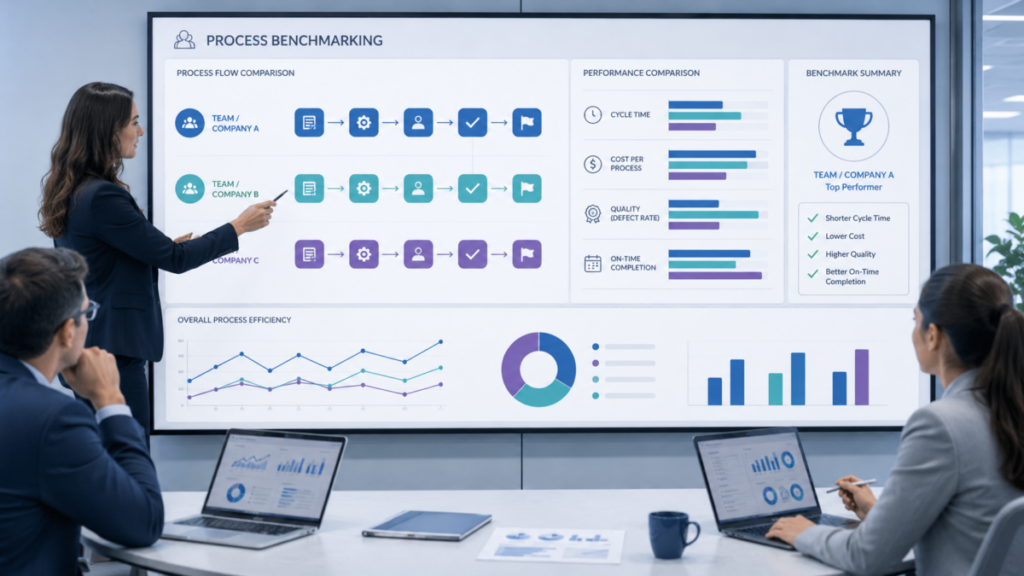
Competitor benchmarking can be divided into three main types depending on the objective.
- Performance benchmarking
Performance benchmarking compares quantitative metrics such as revenue, conversion rate, customer retention and margin. It helps companies quickly understand whether they are ahead of or behind the market average. However, numbers alone do not explain the cause. Even if a competitor has a higher conversion rate, further analysis is needed to understand whether the reason is pricing, product features, brand trust or something else.
- Process benchmarking
Process benchmarking looks for the structural reasons why competitors achieve better results. It examines how competitors operate across product development, supply chain, customer support, sales processes and data usage. Because this type of internal information is often difficult to confirm through public sources, interviews with former employees, current practitioners or industry experts can play an important role.
- Strategic benchmarking
Strategic benchmarking compares business models, pricing strategies, market positioning, partnerships and international expansion approaches. It is often used for long term decisions such as new business planning, overseas expansion and M&A. These three types are most useful when combined rather than used separately.

Why Competitor Benchmarking Matters More in 2026
Competitor benchmarking has always been important, but in 2026 its importance has become even greater. There are three main reasons.
- Market change has accelerated.
- AI is changing the way companies compete.
- Public information alone is no longer enough to understand how competitors are actually moving.
In the past, companies could often build strategies based on annual reports, industry reports and periodic market research. Market change was slower and competitive landscapes were more stable. Today, the situation is different. AI based product improvement, automated marketing, real time pricing changes, platform based distribution and global supply chain restructuring are happening at the same time.
In this environment, data from six months ago may already be outdated. This is especially true in technology, ecommerce, SaaS, manufacturing, healthcare, finance and consumer goods markets, where competitor product features, pricing policies, distribution strategies and customer acquisition methods can change within short cycles. Some competitors quickly adjust internal operations or customer segment strategies without making formal announcements.
The issue is that these changes are not immediately reflected in public information. Company announcements usually show only part of a strategy that has already been executed. Industry reports are useful, but there is a time gap between research, writing and publication. News articles may capture major changes, but they often do not reveal practical operating methods or the decision making context behind them.
As a result, competitor benchmarking in 2026 is becoming less about collecting as much information as possible and more about quickly understanding what is actually happening in the market right now.

The Limitations of Traditional Competitor Benchmarking
Traditional competitor benchmarking is usually based on publicly available sources such as company websites, investor materials, news articles, industry reports, customer reviews, job postings, app reviews and website traffic data. These sources are useful for understanding the broad market landscape and identifying a competitor’s official messaging and external activities.
However, public information alone cannot fully explain a competitor’s actual strategy or operating model. You may know that a competitor launched a new product, but it is difficult to know why they launched it, which customer segment they were targeting or what internal results they expected. You may know that a competitor changed its pricing, but it is difficult to know how that pricing is applied in the field, what terms are offered to large customers or how customers responded.
Another limitation is the time gap. Industry reports take time to produce and publish. News articles and public announcements often show only part of a strategy that has already been implemented. In fast moving markets, this time gap can reduce the quality of decision making. For decisions where timing matters, such as overseas market entry or pricing strategy adjustment, outdated information can lead to the wrong conclusion.
| Easier to identify through public sources | Difficult to identify through public sources alone |
|---|---|
| Product launch status | Launch background and internal decision criteria |
| Public pricing pages | Actual contract terms and discount policies |
| Strategy direction mentioned in news | How the strategy is executed in the field |
| Customer reviews and external reactions | The real reason behind churn or conversion |
| Hiring signals and team expansion | Internal priorities and operating structure |
For example, imagine a company preparing to enter a foreign market by comparing local competitors’ websites and pricing pages. On the surface, the price range and product structure may look similar. In reality, however, competitiveness may depend on local distribution partner contracts, sales team discount authority, key customer segments and regulatory response. These differences are difficult to identify through public information alone.
Ultimately, public source based benchmarking is useful for understanding what is visible, but it has clear limitations when it comes to understanding why competitors are moving in a certain direction and how they actually operate. Important strategic decisions are often shaped by these less visible factors.

Building an Effective Competitor Benchmarking Strategy
To conduct competitor benchmarking properly, companies should not approach it as simple information gathering. The objective, comparison targets, metrics, data collection method and execution plan all need to be clear.
1. Define the Objective First
Benchmarking scope and required information change completely depending on the objective. If the goal is pricing strategy, companies need to examine competitor pricing pages, discount structures and contract terms. If the goal is overseas market entry, they need to examine distribution channels, partnerships and regulatory response. Without clearly defining what decision the benchmarking should support, the project can easily end as a collection of disconnected information.
2. Look at Both Direct and Adjacent Competitors
Many companies focus only on direct competitors and miss where market change is actually coming from. In many cases, disruption begins with adjacent competitors or nontraditional players. A financial services company may face competition from fintech companies, big tech firms or payment platforms. An education company may compete with AI tutors or content platforms. Companies need to consider not only current competitors, but also potential future competitors.
3. Select KPIs That Match the Objective
Trying to collect every possible piece of information can make the analysis less useful. The metrics need to match the decision. For ecommerce, this may include conversion rate, average order value and repeat purchase rate. For SaaS, it may include customer acquisition cost, churn rate and customer lifetime value. For strategic benchmarking, companies should also look at qualitative indicators such as market positioning, pricing philosophy and partnership structure.
4. Combine Public Sources with Expert Insights
Public sources such as websites, pricing pages and marketing messages only show part of the picture. True competitiveness often comes from areas that are not visible from the outside, such as internal operating models, sales structures and data usage. Companies should use public sources to understand the broad picture and expert interviews to fill in the gaps. Data shows what happened. Experts explain the context. When the two are combined, benchmarking becomes much closer to practical decision making.
5. Turn Analysis into an Execution Strategy
The final purpose of benchmarking is not to create a report. It is to improve strategy. One important caution is not to copy a competitor’s successful strategy without interpretation. Even if a competitor’s revenue growth is strong, companies need to examine whether it was driven by a temporary promotion or whether it targeted a different customer segment. If resources, brand strength and organizational capabilities are different, the same strategy may not work. Good benchmarking distinguishes what to adopt from what not to adopt and reinterprets insights for the company’s own situation.
Benchmarking should also not be treated as a one time project. When new products launch, prices change or competitors pursue M&A, the benchmarking criteria should be reviewed again.

How to Choose a Competitor Benchmarking Partner
Professional firms that support competitor benchmarking generally fall into two categories. Some firms manage the entire benchmarking process on behalf of the client. Others help companies conduct benchmarking internally by providing the necessary information and connecting them with relevant experts. One type is not always better than the other. The right choice depends on the company’s internal capabilities and the nature of the project. What matters is whether the provider meets the following criteria.
First, check whether the firm can conduct both public source analysis and primary interviews. As discussed earlier, a public source only approach has clear limitations. A strong partner uses industry reports, news, customer reviews and other public information to build the broad picture, then fills in the internal context through interviews with former employees, current practitioners or industry experts. It is also important to check how broad and well vetted the firm’s expert network is and how quickly it can connect you with the right profiles.
Second, check whether the firm has practical understanding of the relevant industry. Benchmarking is not just about collecting metrics. It is about interpreting the context behind those metrics. The same churn rate can mean different things in SaaS and ecommerce. The same price increase can be an aggressive growth strategy in one market and a defensive move in another. The partner needs to understand your industry structure and competitive logic for the output to support real decision making.
Third, check whether the final output is actionable. A report that summarizes competitor activity is different from a report that explains what your company should change. A strong partner does not stop at describing what competitors are doing. It also helps translate those findings into directions that your company can actually apply.
Fourth, check whether the firm has experience with similar project objectives. Benchmarking for new market entry and benchmarking for pricing strategy require different information and different analytical approaches. If the firm has completed similar projects before, it is more likely to focus on the right questions from the beginning.

Real Competitor Benchmarking Use Cases
Among the various competitor benchmarking methods discussed above, Liahnson & Company helps clients access people who have worked directly at leading companies or competitors relevant to the benchmarking objective. The core approach is to gain insight through one on one expert interviews. Below are two examples of competitor benchmarking projects conducted through Liahnson & Company.
Case 1. Global Benchmarking for a Spatial Data Technology Company
A spatial data technology company wanted to compare the competitiveness of its solution against global leaders such as Trimble, Matterport, Picterra and Orbital Insight. The objective was not simply to list product features, but to structurally compare each company’s business model, workflow and strategic positioning.
To support this project, in depth interviews were conducted with more than 10 former and current practitioners from the target companies. As a result, the client was able to clearly understand where global standards were forming and how leading companies were differentiating themselves. Through expert interviews, the client also gained evidence to validate its own strategic direction and set practical priorities for product development.
Case 2. Amazon Strategy Benchmarking for a Korean F&B Brand
A major Korean F&B brand wanted to benchmark competitors’ Amazon sales and marketing strategies in the United States. Because confidentiality was critical, the interview structure was designed so that the client’s questions were delivered to experts through an intermediary and a moderator.
Former and current practitioners who had directly managed Amazon marketing at competitor companies were quickly identified. Six expert profiles were shared within 10 minutes and the full set of interviews was completed within one week. The client gained practical insight into competitors’ Amazon operations and marketing strategies while maintaining strict confidentiality throughout the project.
Competitor benchmarking is ultimately a process for better decision making. As these two cases show, strong benchmarking begins with the right questions and the right people who can answer them.
Conclusion
Competitor benchmarking is not simple information gathering. It is the process of understanding your company’s market position, identifying strengths and weaknesses compared with competitors and deciding which strategy to pursue next. In fast moving markets, public information and static reports are not enough. Competitor products, pricing, operations, customer experience, supply chains, sales methods and market entry strategies continue to change, and the most important changes are often not clearly visible from the outside.
In this environment, expert network services can increase the speed and depth of competitor benchmarking. Through interviews with vetted industry experts, companies can access practical context, decision making background and real market direction that are difficult to identify through public sources alone. Ultimately, competitive advantage does not belong simply to companies with more data. It belongs to companies that ask better questions and access realistic insights faster.
Competitor benchmarking is the starting point. Expert network based competitor benchmarking can be one of the most powerful ways for companies to make faster and more accurate strategic decisions in a changing market.