
Ask most people what “bioplastic” means, and you’ll get some version of “eco-friendly material” or “the good kind of plastic.” That framing misses what’s actually happening in the market today. Bioplastics have moved well past the branding conversation and into a genuine competitive arena, one defined by who sets the standards first and who builds a compliant certification infrastructure fastest. The European Union is rewriting market-access conditions through packaging regulation. Japan is using certification to control the terms of entry. Brazil is competing on feedstock economics. Southeast Asia is competing on manufacturing scale. This piece maps the regulatory backdrop and the divergent national strategies at play, and closes with a look at what this all means for everyday consumers.

Why Bioplastics, Why Now
The renewed attention on bioplastics isn’t a story about a sudden technology breakthrough. It’s a story about regulation. The EU’s Packaging and Packaging Waste Regulation (PPWR) is fundamentally resetting how companies need to think about packaging materials, bioplastics included. Until recently, most companies treated a switch to eco-friendly packaging as a brand-image exercise, a nice-to-have rather than a necessity. Under PPWR, that calculus changes. What a package is made of, whether that material is recyclable, whether it’s free of hazardous substances and whether the right documentation exists now determine whether a product can even enter the EU market. Bioplastics have shifted from “a good option” to “a mandatory line item in the compliance review.”
Each region is responding to this shift differently. Japan is getting ahead of the curve by establishing standards and certification schemes first. Brazil is leveraging feedstock economics to plug bioplastics directly into its existing industrial base. Southeast Asia is consolidating manufacturing infrastructure to position itself as a production hub.
The Regulatory Pressure Point: PPWR’s Timeline
The single most important thing to understand about the bioplastics market isn’t the technology, it’s the regulatory calendar. Here’s the timeline for the EU’s Packaging and Packaging Waste Regulation (Regulation (EU) 2025/40):
- January 22, 2025: The PPWR was published in the EU Official Journal.
- February 11, 2025: The Regulation formally enters into force, 20 days after publication.
- August 12, 2026: The main provisions become directly applicable.
The takeaway for business leaders: “we’ll deal with it next year” is no longer a viable posture. This is a design-phase problem that needs to be solved before products hit the market. PPWR isn’t a light-touch nudge toward “use less packaging”; it bundles recyclability requirements, restrictions on hazardous substances, mandatory declarations of conformity, Extended Producer Responsibility (EPR) registration, labeling standards and reuse-system requirements into a single regulatory package. Without an enterprise-wide data infrastructure covering packaging, market entry into the EU becomes genuinely difficult.
In practical terms, here’s what companies now need to manage:
- Food-contact packaging is subject to restrictions on PFAS (per- and polyfluoroalkyl substances), requiring a full review of raw materials, coatings, and adhesives.
- Heavy metals and other hazardous substances require documented conformity assessments.
- Every product needs a declaration of conformity, test reports, technical files and supply-chain documentation, organized and audit-ready.
- Companies need to evaluate EPR registration requirements and representative obligations on a country-by-country basis.
- Material labeling and waste-sorting information must meet standardized formats.
- Reuse systems, covering collection, cleaning and reintegration into supply, need to be designed into logistics, returns and inventory operations.
Industry compliance guides consistently point to PFAS and heavy metal restrictions, recyclability, labeling, traceability and conformity documentation as the core requirements for food-contact packaging. The implication is straightforward: when evaluating a bioplastic material today, documentation readiness matters at least as much as the underlying material science.
There’s a common misstep worth flagging here: assuming you can simply “sell through existing inventory” and deal with compliance later. Even if the base material is switched to a bioplastic, if the adhesives, coatings, inks and labels haven’t changed, the regulatory exposure hasn’t gone away either.
It’s also worth remembering that the EU isn’t one market. It’s 27 member states, each with its own EPR registration process, distribution structure and collection system that need to be verified individually. What looks like a single packaging change quickly becomes a cross-functional initiative touching procurement, legal, quality, ESG and logistics simultaneously.
This is also where bioplastics connect naturally to net-zero supply chain transitions. The moment a company changes its packaging, feedstock sourcing, carbon accounting, waste recovery and recyclability verification all become linked. Bioplastics, in other words, shouldn’t be understood simply as “a lower-carbon material.” They need to be understood as a material that simultaneously satisfies regulatory compliance and carbon management requirements. And that August 12, 2026 deadline mentioned above isn’t a soft target; it’s the point by which companies need to have completed the transition from pilot programs to commercial-scale supply. If your team is still working out how PPWR’s documentation and EPR requirements map onto your specific product line, it may be worth a direct conversation with someone who tracks these regulations closely — reach out and we can walk through it together.
Japan: Winning Through Standards and Certification
Japan isn’t competing on cost in the bioplastics market. Instead, it’s using government- and industry-association-led standardization and certification to set the rules of the game before anyone else does. The Japan BioPlastics Association (JBPA) is the central body driving this, running the testing standards and labeling systems that govern biodegradability (a material’s ability to break down naturally) and compostability. Simply claiming that a product uses bio-based materials is not enough to compete here.; companies need to actually pass JBPA’s testing regime. That’s a real barrier to entry, but it’s also what gives certified materials a credible trust signal once they clear it.
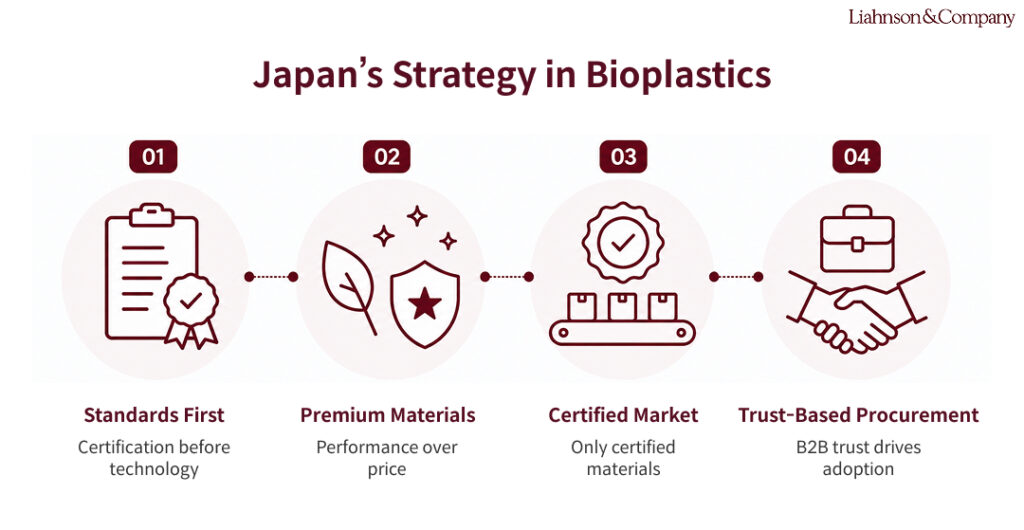
Japan’s strategy rests on four pillars:
- Standards-first positioning: prioritizing specifications and certification ahead of raw technical capability.
- Premiumization: focusing on functional improvements, including better biodegradation performance, heat resistance, and processability.
- Market ordering: favoring a structure where only certified materials get distributed and procured.
- Trust-building in procurement: exerting influence through B2B procurement relationships rather than direct-to-consumer persuasion.
The advantage of Japan’s approach isn’t “build a good material fast.” It’s “clearly define which materials are safe for anyone to use.” Take a food-packaging bioplastic film as an example: in Japan, that material gets scrutinized on whether it’s actually compostable, under what conditions it decomposes and whether it’s eligible to carry a certification label. The process looks slow, but clearing it earns genuine premium positioning.
The practical implication for companies targeting Japan: lead with your test reports and labeling credentials, not your technology pitch. That’s why in-house R&D capability often matters less here than relationships with external testing labs, regulatory consultants and procurement specialists with market experience. Japan is a market where standards and trust carry more weight than sheer scale, which is exactly why bioplastics here can’t be evaluated on unit price alone.
Brazil: Sugarcane-Powered Feedstock Advantage in Bio-PE/PP
Brazil’s core asset is sugarcane. Ethanol derived from sugarcane feeds into bio-based ethylene production, which in turn underpins Brazil’s competitiveness in drop-in materials like bio-based polyethylene (bio-PE), allowing the country to maintain strong compatibility with existing petrochemical infrastructure. A “drop-in” material is chemically near-identical to its fossil-based counterpart, meaning manufacturers can substitute it without significant retooling of production lines. Brazil, in short, isn’t in the business of inventing new materials. It’s in the business of replacing existing plastics as seamlessly as possible.
The commercial logic here is compelling. Manufacturers gravitate toward drop-in materials precisely because they don’t require major capital expenditure on new equipment, letting companies cut conversion costs while still delivering on ESG (Environmental, Social and Governance) commitments and sustainability messaging.
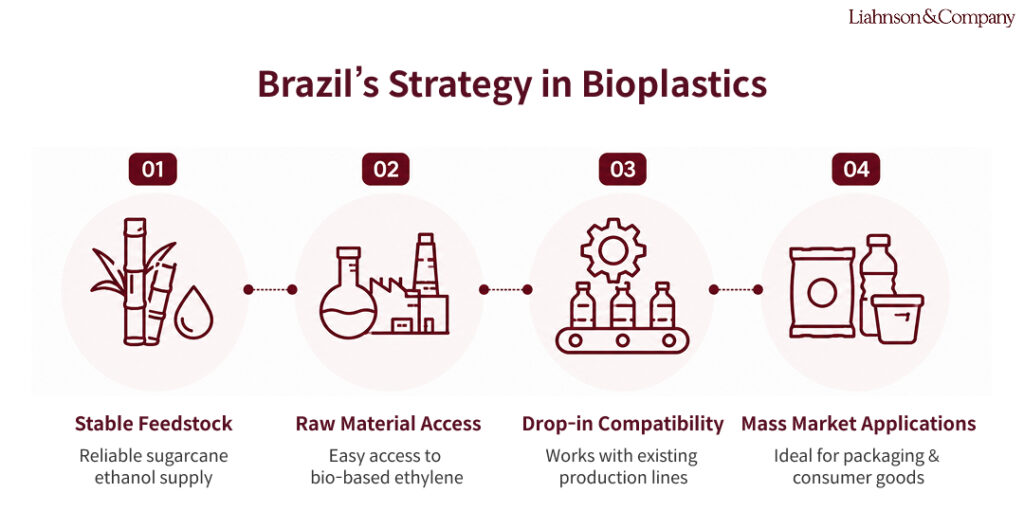
Brazil’s specific advantages break down as follows:
- A large, well-established sugarcane ethanol supply chain.
- Strong feedstock access for bio-based ethylene production.
- High compatibility between drop-in materials and existing petrochemical production lines.
- Relatively easy adoption in high-volume categories like packaging and consumer goods.
Bio-PE in particular shares physical properties closely with fossil-based polyethylene, which lowers commercialization barriers across packaging, film and household products, a big part of why major retailers and consumer goods manufacturers are paying attention to Brazilian bioplastics. Braskem, Brazil’s leading chemicals company, has been vocal about scaling up bio-based plastics production from renewable feedstocks. The takeaway: Brazil is simultaneously building out feedstock advantage and unit-cost competitiveness in the drop-in bio-PE/PP category.
That said, there’s a common blind spot in evaluating the Brazilian opportunity: assuming sugarcane-based automatically means cheap. In reality, you need to factor in feedstock price volatility, harvest seasonality, logistics and port infrastructure, currency exposure and long-term contract terms together. Sugarcane feedstock doesn’t guarantee low cost. What actually determines competitiveness is how well feedstock sourcing connects to export infrastructure.
Consider a global beverage company evaluating a switch to bio-PE for bottle labels and packaging film. The relevant question isn’t “is this the eco-friendly choice”; it’s whether the material is compatible with existing equipment, what the unit economics look like at volume and whether it satisfies country-specific regulatory requirements. Bottom line: Brazil is better understood as a symbol of substitutability rather than biodegradability.

Southeast Asia: The Manufacturing Hub and Low-Cost Infrastructure Race
Southeast Asia is where the push to become a bioplastics manufacturing hub is most visible right now, with Thailand leading and Indonesia following close behind. This region’s edge lies less in technology leadership and more in production consolidation and feedstock utilization. Thailand has made becoming a bioregional industrial hub a formal national policy objective, and in 2026, the startup of a major PLA production facility by NatureWorks, the world’s largest PLA (polylactic acid, a leading biodegradable plastic made from plant-based feedstocks like corn or sugarcane) producer, reinforced Thailand’s position as a genuine production base. The facility runs on locally sourced Thai sugarcane, marking a symbolic shift for Southeast Asia from an assembly hub to a bio-material production base.
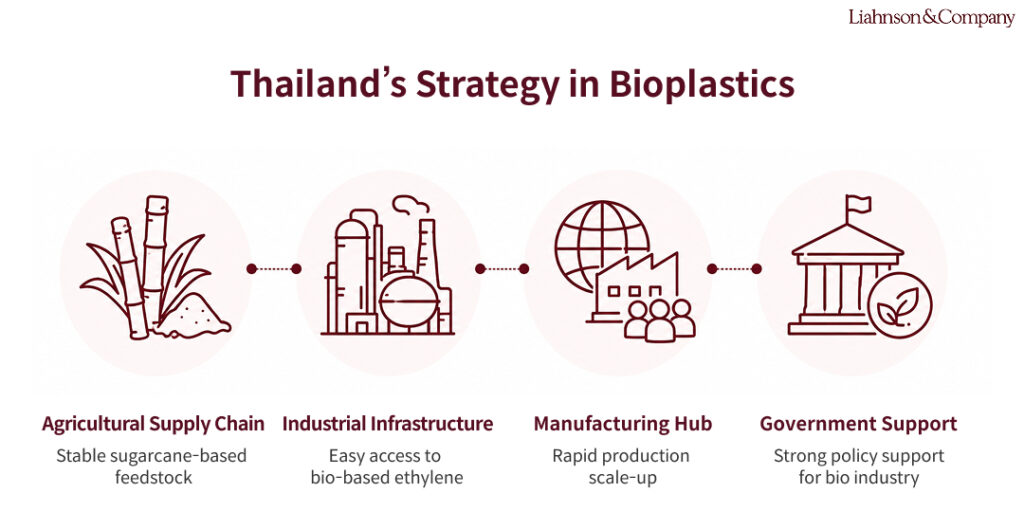
Several factors are converging to make Thailand a hub:
- An agricultural supply base anchored in sugarcane and related crops.
- Relatively mature industrial-park and chemical infrastructure.
- An environment where foreign investment translates quickly into production consolidation.
- Clear government commitment to growing the bio-industrial sector.
Thailand’s real advantage isn’t any single company’s success. It’s an integrated value chain running from raw feedstock through to finished product. NatureWorks’ new PLA facility reinforces this: Thailand is moving beyond a contract-manufacturing role toward a more fully integrated regional production base, spanning the value chain from feedstock sourcing through production.
Indonesia occupies a different position. Its large agricultural base and biomass potential (agricultural crops and byproducts as a biological resource) give it real long-term promise as a low-cost feedstock source. But commercialization there depends on more than feedstock access; power infrastructure, logistics, permitting and quality-control systems all need to mature as well. Indonesia is best understood not as a near-term global supplier, but as a market building long-term low-cost production infrastructure.
Southeast Asia overall is transitioning from a “low-cost production zone” to a “large-scale bio-material production base,” with Thailand moving faster on hub formation and Indonesia carrying greater long-term potential. But as global buyers increasingly demand supply-chain carbon data, certification and recyclability, the more relevant question is shifting from “is this a production site” to “is this a production site capable of meeting international standards.”
How Bioplastics Will Actually Reshape Our Daily Lives
At this point, the bioplastics story might feel like something that only concerns materials companies or regulatory affairs teams. Look a little closer, though, and this shift is quietly reshaping daily life in ways that are much closer to home than they appear. The water bottle you drink from in the morning, the padding inside a package you ordered online, the snack bag you grab at the grocery store, all of it eventually arrives in your hands as a downstream product of this large-scale regulatory and standards competition.
That wrapper you toss without a second thought may well have passed through a European regulator’s desk, a Japanese certification body, a Brazilian sugarcane farm and a Thai chemical plant on its way to you. As this regulatory infrastructure matures, expect it to show up on price tags. Certification and feedstock-conversion costs tend to get passed through to consumer prices one way or another, though on the flip side, materials produced at scale in feedstock-advantaged countries could end up costing less than what’s on shelves today. There’s also a longer-term dimension here: what’s left behind for the next generation. How long today’s plastics take to break down and the traces they leave in soil and ocean shape the conditions the next generation will inherit, which is precisely why the EU and Japan are pushing such rigorous regulatory and certification standards.
This shift is also quietly reshaping the employment landscape across the value chain: farmers growing feedstock crops, researchers developing new materials, certification specialists and packaging designers are all seeing their roles redefined right now. You don’t need a chemistry background to engage with this. Simply understanding that a piece of packaging or a bottle of water carries this much national-level competition and generational stakes behind it is enough to broaden how you see the world around you.
Whoever Sets the Standard Wins the Market
As this analysis shows, the bioplastics competition isn’t really a materials contest. It’s a multi-layered contest over standards, feedstock, certification and supply chains. The EU is using regulation to redefine market access; Japan is using certification to build trust; Brazil is using feedstock economics to lower the barrier to commercialization; Southeast Asia is using manufacturing scale to build out an industry. The question that matters isn’t “how eco-friendly is this material” but “can this material actually pass regulatory review, earn certification, meet cost targets and connect to real business and consumer needs.” Companies that build durable supply agreements and certification infrastructure, rather than chasing short-term pilots, are the ones likely to come out ahead.
Here’s a summary of the regional strategies covered in this piece:
| Region | Core Strategy | Strength | Key Operational Consideration |
|---|---|---|---|
| European Union | Regulation-driven market redesign (PPWR) | Strong legal enforceability, market-access gating | Most provisions apply from August 12, 2026, so data infrastructure needs to be ready in advance |
| Japan | Standards and certification leadership | Trust-based, high-value-added market | Passing JBPA testing and labeling standards is the key entry hurdle |
| Brazil | Feedstock advantage (sugarcane-based) | Drop-in materials compatible with existing equipment | Feedstock pricing, logistics and export infrastructure all need joint evaluation |
| Southeast Asia (Thailand, Indonesia) | Manufacturing hub formation | Large-scale production consolidation, integrated value chain | Whether the site can meet international standards is the deciding factor |
This competition is only just getting underway. Once PPWR takes full effect on August 12, 2026, the ripple effects will extend well beyond EU-facing exporters to domestic suppliers, raw material vendors and logistics partners. Japan’s certification regime, Brazil’s feedstock advantage and Southeast Asia’s hub formation are all advancing at their own pace, and the outcome of all this will eventually show up on the price tags and packaging we encounter every day, as well as in the environment the next generation inherits. Understanding this shift early is likely to serve as a useful compass for the choices ahead, for all of us.

Source
https://www.ul.com/resources/packaging-european-packaging-and-packaging-waste-regulation
https://www.argusmedia.com/ja/news-and-insights/latest-market-news/2480382-braskem-scgc-tie-up-on-bio-based-pe-plant-in-thailand
https://www.jbpaweb.net