
The concept of CBAM first appeared in 2019. When the EU introduced the European Green Deal and signaled that carbon costs would eventually be imposed at its borders, most companies viewed it as a distant, long-term issue. A draft followed in 2021, and the regulation was formally adopted in 2023.
In October of that year, reporting obligations began. After more than two years, in January 2026, the system finally moved into its cost phase.
CBAM was not a sudden change. It was clearly signaled and gradually implemented. Yet many companies have reached this point without being fully prepared.
In this article, we will review the background of CBAM and provide a practical guide to help companies respond effectively. Any country or company involved in exporting to or importing from Europe should understand this framework.
What is CBAM?
The EU Carbon Border Adjustment Mechanism (CBAM) is a system that applies a carbon cost to goods imported into the EU based on the emissions generated during their production process.
It is not a traditional tariff. Instead, it functions as a carbon cost adjustment mechanism linked to the EU Emissions Trading System (ETS).
Purpose and Structure
CBAM was introduced to prevent carbon leakage, a phenomenon where companies relocate production to countries with weaker carbon regulations to avoid higher costs.
By applying comparable carbon costs to imports, the EU aims to prevent this shift and maintain its overall decarbonization pathway.
The structure is relatively simple:
· EU importers must declare the carbon emissions of imported goods
· They must purchase CBAM certificates corresponding to those emissions
· If carbon costs have already been paid in the exporting country, partial reductions may apply
In other words, CBAM is not simply a cost-imposing mechanism. It is a system in which the actual burden varies depending on a company’s carbon data and management capability.
Target Products
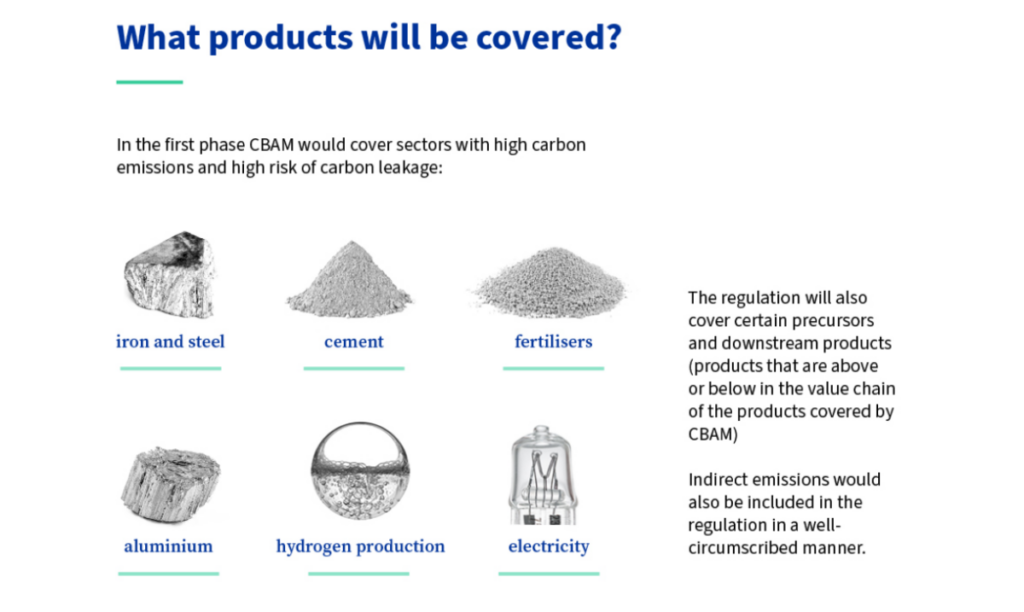
CBAM initially focuses on carbon-intensive industries.
It currently applies to core sectors such as steel, cement, aluminum, fertilizers, electricity, and hydrogen. However, the scope is expected to expand. From around 2028, the EU is considering extending CBAM to downstream products that include steel and aluminum, such as automotive components, machinery, and appliances.
This means that the impact will not remain limited to raw materials, but may extend to finished goods and broader manufacturing supply chains.

CBAM Certificate Purchase and Cost Calculation Logic
The actual financial impact of CBAM is determined by how certificates are purchased and how emissions are calculated. For companies, understanding this structure is critical, as it directly affects internal processes, pricing, and supply chain decisions.
1. Certificate Purchase Mechanism: Linked to EU ETS Pricing
Importers are required to purchase CBAM certificates based on the weekly average price of EU emission allowances.
The structure can be summarized as:
Import volume × Carbon intensity × EU carbon price
This means that products with higher carbon intensity, such as steel or aluminum produced using coal-based energy, are likely to face immediate disadvantages in price competitiveness.
2. Emissions Calculation
· Scope 1 (Direct emissions)
These include emissions generated directly from fuel combustion, industrial processes, and on-site operations such as factory vehicles.
· Scope 2 (Indirect emissions – electricity, heat)
These are calculated by applying grid emission factors to electricity and heat consumption, reflecting embedded carbon in energy use.
· Scope 3 and downstream embedded emissions
As CBAM expands to downstream industries after 2028, including automotive, machinery, and appliances, tracking Scope 3 emissions across the entire supply chain, from raw materials to transport and product use, may become effectively mandatory.
3. Adjustment Mechanism: Deduction of Carbon Costs Already Paid
CBAM includes a mechanism that allows companies to reduce their burden if carbon costs have already been paid in the exporting country. This may include carbon taxes, emissions trading schemes, or carbon-related costs embedded in electricity and fuel.
However, such adjustments are not automatic. To qualify, companies must provide:
· Proof of carbon cost payments
· Verified emissions data at the process or facility level
Because of this, data availability and reporting capability become key variables in determining the actual level of cost reduction. Companies with more detailed and verifiable data are in a stronger position to optimize their CBAM costs.

CBAM Implementation Roadmap (2023–2034)
As discussed earlier, CBAM was not introduced suddenly but has been implemented in phases since 2023. As of January 2026, it has entered its full implementation stage. Understanding how this timeline unfolds is important for anticipating what comes next and preparing accordingly.
1. Transition Phase (October 2023 – December 2025): Reporting-Driven Stage
From October 2023 to the end of 2025, CBAM operated as a transition phase. During this period, there was no financial burden, but companies were required to report import volumes and embedded carbon emissions.
At this stage, the focus was on building systems rather than managing costs. Companies were expected to develop emissions calculation methodologies, organize data structures, and align reporting formats with EU requirements.
Key developments during this phase included:
· Carbon data reporting became mandatory even without cost implications
· Emissions calculation systems were established at both process and supply chain levels
· Data collected during this period became the foundation for future cost calculations
In other words, this period was not just a preparation phase. It effectively defined the baseline that now determines actual CBAM costs and potential adjustment eligibility.
2. Full Implementation (January 2026): Carbon Costs Become Real
Starting in January 2026, CBAM entered its operational phase, and importers are now required to purchase certificates based on actual emissions. This means that carbon costs are directly reflected in import pricing.
As a result, several changes have already become visible in the market:
· Products with higher carbon emissions are experiencing rising import costs
· Price competitiveness is weakening in certain sectors
· Products produced using low-carbon processes or clean energy are gaining relative advantage
This marks a clear shift where carbon is no longer an indirect factor. It is now embedded in pricing and directly influencing market outcomes.
3. Expansion Phase (From 2028): Supply Chain-Wide Impact
Currently, CBAM applies primarily to carbon-intensive base industries such as steel, cement, aluminum, fertilizers, electricity, and hydrogen. However, the EU is considering expanding its scope to include downstream products such as automotive parts, machinery, and appliances.
If this expansion takes place, the impact will extend beyond individual industries to entire supply chains.
Key changes expected in this phase include:
· Expansion from raw materials to finished goods
· Impact shifting from specific industries to full supply chains
· Carbon data becoming a required element rather than a compliance option
At this stage, products without verifiable emissions data may face significant barriers to market access.
4. Phase-Out of Free Allocation (2031–2034): Maximum Impact Period
The EU plans to gradually reduce free allocation of emission allowances starting in 2027, with the expectation that it will approach zero by 2034.
From around 2031 onward, the structure changes significantly. EU companies will begin to bear most of their carbon costs directly, which increases the relative impact of CBAM on imported goods.
Key implications include:
· EU producers taking on full carbon cost exposure
· Increased relative cost pressure on imports
· Carbon costs becoming a core determinant of competitiveness
This period is expected to represent the point at which CBAM’s impact is fully realized.
Impact on Global and Asian Supply Chains
CBAM is no longer limited to EU regulation. It is increasingly shaping global supply chains and trade structures. The impact varies depending on production location, energy mix, and the ability to manage carbon data, which means the effects differ significantly across countries and industries.
Global Perspective: Reshaping Competitive Structures Through Carbon
From a global perspective, CBAM is accelerating changes in competition, particularly in carbon-intensive industries. Studies have identified countries such as Turkey, Brazil, South Africa, Canada, China, and India as major exporters of CBAM-covered products to the EU. These countries are expected to face growing pressure as higher carbon costs reduce price competitiveness in sectors such as steel, aluminum, and cement.
At the same time, producers in regions with a high share of renewable energy and low-carbon power are positioned more favorably. Countries such as Norway, Iceland, France, and Germany are likely to gain a relative advantage.
This shift creates a new dynamic in which products within the same industry are valued differently depending on their emissions profile. Carbon intensity is becoming a factor that directly influences pricing and competitiveness.
Asia as a Manufacturing Hub: Shared Exposure, Different Outcomes
Asia is one of the regions most exposed to CBAM due to its role as a global manufacturing hub. However, the impact is not uniform, and outcomes vary depending on each country’s energy structure and level of carbon management.
· China and India
These countries rely heavily on coal and have large-scale production in carbon-intensive industries such as steel, aluminum, and cement. As a result, they are expected to face both higher cost pressure and demand risks in exports to the EU.
· Japan and Singapore
These countries are relatively better positioned due to lower dependence on EU exports and more developed carbon pricing and reporting systems. However, as CBAM expands to advanced manufacturing sectors, they may face increasing demands for more detailed emissions data.
· Korea
Korea faces a dual challenge. It has a high level of exposure in industries such as steel, automotive, electronics, and batteries, which are closely linked to both upstream materials and downstream products affected by CBAM. At the same time, Korea has an established emissions trading system and relatively advanced carbon reporting infrastructure, which provides a foundation for faster adaptation.
· Southeast Asia including Vietnam, Indonesia, Thailand, Malaysia, and the Philippines
These countries tend to have energy-intensive industrial structures and a high reliance on coal. Many manufacturing operations function as global production hubs, which makes carbon tracking and accountability more complex. As CBAM expands, products that are low in cost but lack reliable carbon data may lose their competitiveness, and production may shift toward locations with more transparent and lower-carbon supply chains.
Although Asia shares a common exposure to CBAM, the required response strategies differ significantly depending on each country’s industrial structure and role in global supply chains.
Practical Guide: Supply Chain Transformation Through Low-Carbon Transition
CBAM cannot be addressed as a simple compliance issue. In the short term, companies need to establish data and reporting systems, but over the medium to long term, they must redesign their energy structure and supply chains. As carbon costs are expected to increase significantly after 2031, companies should approach this with a three to ten year strategic perspective.
1. Improving Energy Mix: Transition Away from Carbon-Intensive Fuels
The most fundamental way to reduce emissions is to improve the energy mix. This means shifting away from coal, heavy oil, and other carbon-intensive fuels toward natural gas, electricity, and cleaner energy sources.
At the same time, companies need to reduce total energy consumption for the same level of output. This includes process optimization, heat recovery, and better coordination across the supply chain. Global research consistently highlights that improving processes, energy usage, and supply chain efficiency together is the key to CBAM readiness in the 2030s.
For Korean companies and other export-oriented manufacturers, relocating or expanding production in regions with a higher share of renewable or low-carbon energy is also becoming a realistic option.
2. Securing Renewable Energy: PPA, RE100, and Carbon Reduction Strategy
Strategies such as long-term power purchase agreements, green electricity contracts, and participation in RE100 are becoming more widely adopted. These approaches reduce product-level emissions while also strengthening market positioning.
This is no longer just about sustainability. Many EU buyers already incorporate renewable energy usage and carbon data into supplier evaluation. After CBAM, carbon data and renewable energy share are likely to become as important as price and quality in supplier selection.
3. Managing Scope 3 Emissions: Extending Carbon Management Across the Supply Chain
As CBAM expands, managing emissions within a company is no longer sufficient. Emissions across the entire supply chain, including raw materials, components, transportation, and services, are becoming increasingly important.
Companies need to require carbon data from suppliers, include carbon-related clauses in contracts, and establish systems to assess supplier-level carbon risk. In practice, this leads to supply chain restructuring. High-emission suppliers are gradually replaced or improved through joint efforts, while low-emission partners are strengthened through long-term contracts and closer collaboration.
Key Risks Companies Tend to Miss
The biggest risks in CBAM are often not the direct costs, but gaps in preparation. Many companies focus on carbon pricing, but fail to secure reliable emissions data, overlook supply chain dependencies, or encounter issues in reporting and verification.
In addition, the market is already shifting. Buyers are beginning to evaluate suppliers based on carbon performance, not just price and quality. Companies that delay their response may face not only higher costs but also reduced access to business opportunities.
The most critical risk is not knowing what is missing. Without a clear understanding of current readiness, it is difficult to prioritize actions or identify vulnerabilities.
In these situations, insights from practitioners with direct industry experience can help companies better understand real market expectations, supply chain risks, and practical response strategies. If you want direct guidance from experts in a simple and practical way, Liahnson & Company can help you quickly get the answers you need.
Conclusion
CBAM is no longer a future regulation. It is already affecting pricing, sourcing, and competitiveness. Companies that act early on data, energy, and supply chain strategy will be better positioned as carbon becomes a core factor in global trade. In an environment of uncertainty, combining internal analysis with practical insights from experienced professionals can provide a more effective path forward.

Sources
https://www.fastmarkets.com/insights/provisional-cbam-benchmarks-announced-how-will-this-restructure-global-trade/
https://asuene.com/us/blog/industry-spotlight-cbams-effect-on-the-global-steel-market
https://theasiagroup.com/the-big-picture-how-the-indo-pacific-is-navigating-europes-carbon-tax/
https://orfme.org/research/the-eus-cbam-and-gulf-countries-an-analysis-of-early-evidence
Latest Posts
- How to Do Competitor Benchmarking: Methods, Use Cases and How to Choose the Right Expert Network Partner
- Bugmageddon and AI Cybersecurity: What Businesses Should Prepare for in 2026
- Agentic Commerce: How AI Agents Are Redefining the Future of Commerce
- Global Market Research: The First Decision That Determines Your International Expansion
- What Is a Customer Experience Company in Korea? A Practical Guide to CX Strategy and Execution