
If your company is planning to expand in the Korean market or develop a new strategy, there is one question you will inevitably face:
Which market research company in Korea should you choose?
Selecting a research partner is no longer just about collecting data. If you are looking for research that delivers actionable insights and clear strategic direction, your selection criteria need to be much more refined.
This is especially true in Korea, where market dynamics shift rapidly and industry structures vary significantly. Relying solely on global research frameworks often leads to gaps in understanding.
In this article, we provide a structured guide for decision-makers and practitioners searching for a market research company in Korea, covering everything from the role of research firms to selection criteria and company types that best fit different project needs.

What is a Market Research Company?
A market research company is not simply an organization that conducts surveys. It plays a critical role in supporting business decisions by collecting, analyzing, and translating market, consumer, and industry data into strategic insights.
Many people use the terms “market research” and “research agency” interchangeably, but there are clear distinctions:
Market Research vs General Research vs Market Research Company
| Category | Description |
|---|---|
| Market Research | The act of investigating consumers, market size, and trends |
| General Research | Broader analysis including industry, technology, and competitors |
| Market Research Company | A specialized organization that designs, executes, and analyzes research |
In other words, a market research company is not just an execution vendor. It is closer to a strategic partner that defines problems, designs methodologies, and interprets results.
Why Do You Need a Market Research Company?
Although companies can collect data internally, there are clear limitations:
- Internal teams may struggle to maintain objectivity
- Poor survey design can lead to flawed questions
- Response quality management is difficult to control
- Industry-level interpretation is often limited
This becomes even more critical in B2B research or new business validation, where raw data alone is insufficient. What matters is interpretation based on real industry experience, which is difficult to achieve without external expertise.
This is why companies increasingly look for research partners that combine industry understanding with expert network capabilities.

Why Market Research is Critical in Korea
The Korean market has a uniquely dynamic structure compared to global markets. It is not just fast-moving. It is characterized by intense competition, rapid trend cycles, and highly responsive consumers.
Key Characteristics of the Korean Market
- Extremely fast-changing trends Products and services gain or lose traction quickly, making early validation essential
- Digitally driven consumption Strong reliance on online and mobile channels creates abundant data but makes interpretation more complex
- Significant industry variation Industries such as IT, content, and beauty grow rapidly, while traditional sectors operate under entirely different dynamics
- High consumer expectations Consumers expect high quality, strong branding, and seamless experiences, making price competition alone insufficient
Market research in Korea is not simply about “asking customers for opinions.” It is a strategic tool used to identify growth segments, understand competitive positioning, evaluate channel performance, and determine pricing thresholds.
In a highly competitive market like Korea, even small decisions can significantly impact revenue and brand perception. This is why the importance of choosing the right market research company in Korea continues to grow.

How to Choose a Good Market Research Company in Korea
When selecting a market research company in Korea, the most important factor is not company size or brand recognition, but problem-solving capability and project fit.
The industry has become increasingly specialized, with distinct expertise across public research, consumer research, B2B research, and panel-based studies. This means that the key question is not
“Which company is the most well-known?”
but rather
“Which company best fits our project?”
1. Understanding of Research Objectives
The first and most critical factor is how well the company understands your research objective. Whether the goal is product testing, brand perception analysis, market sizing, or competitor benchmarking, the research design will differ completely.
A strong research partner does not simply execute a request. Instead, it redefines the objective and proposes the most suitable research structure.
2. Industry Expertise
Research approaches differ significantly across industries such as consumer goods, finance, healthcare, IT, B2B, and public sectors.
A company with strong industry expertise can:
- Design more accurate questionnaires
- Interpret results in a practical, business-relevant way
Without this expertise, you may receive large volumes of data but limited actionable insight.
3. Response Quality Management
In today’s environment, more responses do not necessarily mean better results. Target relevance and response reliability are far more important. This is especially critical in online surveys and panel research, where speed is high but data quality can vary.
It is important to verify:
- How duplicate responses are filtered
- How low-quality or inconsistent responses are identified
4. Depth of Reporting
Some companies provide only cross-tabulated data, while others go further to deliver strategic recommendations based on findings.
From a practical standpoint, the latter is significantly more valuable.
A good market research company in Korea should not only present numbers but also explain:
- Why the results occurred
- What actions should follow
5. Communication Speed and Clarity
Communication is a strong indicator of overall project quality.
You should assess:
- How quickly and clearly they respond before the project begins
- How flexible they are with revisions
- How structured their delivery and follow-up processes are

Selection Criteria Based on Research Method
Not all market research companies in Korea excel at every methodology. In many cases, firms specialize in specific research approaches. Therefore, before selecting a partner, it is important to first clarify what type of research you actually need.
According to recent industry practices, market research can generally be categorized into trend analysis, competitor analysis, customer and target analysis, interviews, surveys, and secondary research. The appropriate method should always align with the project objective, and accordingly, the criteria for selecting a research company will also vary.
Quantitative Research
When quantitative research is required, sampling design and statistical reliability are the most critical factors.
For example, studies measuring brand awareness, purchase intent, satisfaction, or preference rely heavily on numerical comparison. In such cases, ensuring a sufficient sample size and appropriate recruitment method is essential.
Since results are presented in numerical form, even small errors in questionnaire design can significantly distort interpretation.
Qualitative Research
For qualitative research, the capability of the interviewer and the structure of the discussion are more important than scale.
Interviews and focus group discussions are effective for uncovering deep insights into consumer behavior, motivations, and perceptions. However, this requires more than simply collecting opinions.
A strong qualitative research partner must be able to:
- Select the right participants
- Guide conversations effectively
- Extract meaningful patterns from responses
The goal is not just to understand what people think, but why they think that way.
B2B Research and Expert Interviews
B2B research and expert interviews require a completely different approach compared to consumer research. Target respondents may include industry professionals, decision-makers, or technical experts, making recruitment significantly more challenging.
In these cases, companies with access to expert networks have a clear advantage. Beyond recruitment, the research partner must also be capable of:
- Designing relevant interview frameworks
- Conducting structured discussions
- Translating expert insights into actionable outputs
Trend and Industry Analysis
For trend analysis and industry research, the ability to interpret secondary data is more important than conducting primary surveys.
This includes analyzing:
- Public statistics
- Industry reports
- News and competitor materials
In this context, success depends not on data collection, but on how well different data points are synthesized and interpreted.
Summary: Choosing the Right Company by Method
| Research Type | Suitable Use Case | Key Selection Criteria |
|---|---|---|
| Quantitative Research | Awareness, satisfaction, preference, purchase intent | Sampling design, response validation, statistical analysis |
| Qualitative Research | Concept testing, deep customer understanding | Interview design, moderator capability, interpretation |
| B2B Research | Industry experts, practitioners, decision-makers | Expert sourcing capability, industry knowledge |
| Secondary Research | Market size, trends, competitive landscape | Data selection, synthesis, analytical capability |
| Panel Research | Fast execution, repeated measurement, trend tracking | Panel quality, response speed, management system |
By clearly defining your research objective first and selecting a company specialized in that approach, you significantly increase the chances of a successful project outcome.

Checklist Before Requesting Market Research
Before engaging a market research company in Korea, it is essential to clarify what you want to learn and how you plan to use the results. Without this clarity, even well-executed research may fail to support decision-making effectively.
The first step is to define a clear research objective. Whether the goal is product validation, competitor analysis, or brand diagnosis, the research structure will vary significantly. Without a clear objective, results are likely to be ambiguous.
Next, you should define your target audience in detail. Beyond basic demographics such as age, gender, and location, it is important to consider factors such as usage experience, purchase frequency, industry, job function, and decision-making authority. If the target is too broad, results become generalized. If it is too narrow, it may be difficult to secure sufficient samples.
It is also helpful to establish a general direction for the research method in advance. Whether the study involves quantitative surveys, qualitative interviews, or expert consultations will affect both the preparation process and the depth of insights. Projects involving B2B research or expert interviews typically require more time and coordination.
The format of the final deliverable should also be clearly defined. Whether you need a presentation deck, raw Excel data, or a summarized report will determine the scope and level of analysis. Different companies may excel in analysis, visualization, or reporting, so aligning expectations early is important.
Before proceeding, it is recommended to review the following checklist:
- Is the research objective clearly defined
- Are the target conditions specific and well-structured
- Is the research method outlined
- Is the desired output format defined
- Are the timeline and budget realistic
- Is the scope for revisions clarified
- Is raw data required
- Does the final report include actionable insights
By confirming these points in advance, you can ensure that your research delivers not just data, but practical insights that support real business decisions.
Which Market Research Company in Korea is the Right Choice?
If you are selecting a market research company in Korea for the first time, it is advisable to prioritize partners that can support both qualitative research and expert interviews.
In projects such as new business planning, market entry evaluation, or competitor analysis, there is often no single correct answer. In these situations, insights from industry practitioners and experts can provide perspectives that are difficult to obtain through traditional surveys alone.
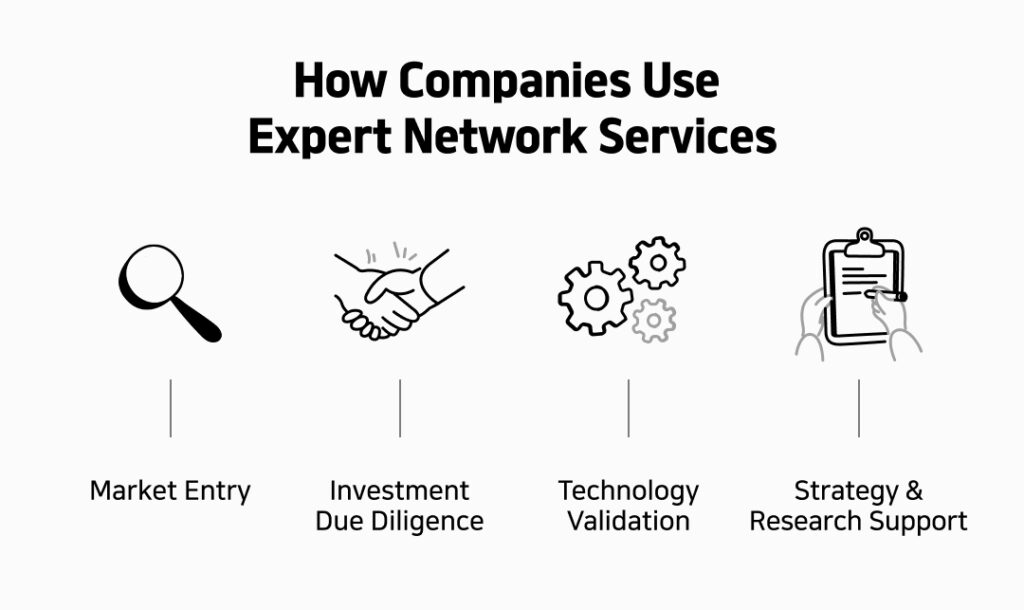
In this context, Liahnson & Company stands out as a research partner specialized in the Korean market. With access to over 5 million expert profiles in Korea, the company enables fast and precise expert matching, making it a strong choice when searching for a market research company in Korea.
Beyond expert sourcing, Liahnson & Company provides end-to-end research support, including interview coordination and research execution. The company also offers AI-powered deep research reports and strategy reports developed by former consultants. AI-driven deep research goes beyond simple data aggregation, quickly scanning market, industry, and company information to identify key variables. Consultant-led strategy reports then translate these insights into actionable strategies and execution plans.
With a structure that combines local market expertise in Korea with global expert network capabilities, Liahnson & Company is particularly well-suited for projects that require both depth and scalability.
Conclusion
Choosing the right market research company in Korea requires more than selecting a vendor that can collect data. It is about finding a partner that can understand the market and industry context, interpret findings accurately, and translate them into actionable insights. By aligning your research objectives with the right methodology and partner, you can significantly improve the impact of your research outcomes.

Sources
https://www.ipsos.com/ko-kr/ipsos-flair-south-korea-2025-byeonhwawa-tamgu