
When working on an investment or M&A project, it is common to review hundreds of pages of reports, datasets, and financial documents. Yet the more data you analyze, the more one fundamental question often arises:
“Do these numbers truly reflect the real condition of the company?”
Experienced investors know that relying solely on numbers can be risky. Financial data can often be presented in ways that look appealing on paper, but that does not always mean it reflects the true operational reality of a business.
In the global M&A market, the following scenarios occur more often than expected:
- A company that appears financially strong loses significant value after acquisition
- A business with impressive revenue growth relies too heavily on a small number of key customers
- A company believed to have strong technology quickly loses competitiveness due to industry shifts
- Organizational performance declines when key employees leave after the acquisition
What these cases have in common is that such risks are rarely visible in financial statements or official documents.
This is why corporate due diligence today has evolved beyond simple financial verification. It has become a strategic process for evaluating a company’s true competitiveness and long-term growth potential.
In this article, we will explore the core concept of corporate due diligence, practical approaches used in investment decision-making, and why insights from industry experts have become increasingly important in modern due diligence processes.

The Meaning and Purpose of Corporate Due Diligence
Corporate due diligence refers to the process of thoroughly evaluating a target company before making major business decisions such as investments, mergers and acquisitions, or strategic partnerships.
This process typically includes reviewing:
- Financial stability
- Legal risks
- Market competitiveness
- Technology capabilities
- Organizational strength
Corporate due diligence is not simply about reviewing documents. It is a strategic analytical process designed to improve the reliability of investment decisions.
In general, corporate due diligence serves three main purposes:
- Identifying potential risks
- Ensuring an accurate valuation of the company
- Developing post-investment or post-acquisition strategies
In the context of M&A, due diligence is particularly critical because the results directly influence whether the deal proceeds and how the acquisition price is determined.
Many failed investments share a common cause: critical risks that were not identified during the due diligence process.
Examples include:
- Companies where more than 60% of revenue comes from a single customer
• Businesses heavily dependent on supply chains from one specific country
• Firms whose core technology has already fallen behind competitors
• Organizations where key management personnel are likely to leave after acquisition
These risks often do not appear clearly in financial reports or investor presentations.
Therefore, corporate due diligence should not be viewed as merely verifying historical data. Instead, it should be understood as a process for evaluating the future competitiveness of a company.

Key Types and Areas of Corporate Due Diligence
Corporate due diligence involves reviewing multiple aspects of a business. The scope of the analysis varies depending on the size of the investment and the characteristics of the industry.
Typically, due diligence can be divided into the following categories:
| Type of Due Diligence | Key Areas Reviewed | Purpose |
|---|---|---|
| Financial Due Diligence | Financial statements, cash flow, revenue structure | Assess financial stability |
| Legal Due Diligence | Contracts, litigation risks, regulatory issues | Identify legal risks |
| Tax Due Diligence | Tax structure, tax liabilities | Evaluate tax exposure |
| Commercial Due Diligence | Market size, competitive landscape | Assess business sustainability |
| Technical Due Diligence | Technology capabilities, R&D | Evaluate technological value |
| Operational Due Diligence | Organizational structure, production efficiency | Assess operational capabilities |
Each area of due diligence focuses on answering key questions such as:
- Is the company’s revenue model sustainable?
- Are there potential legal risks or disputes?
- Is the market actually growing?
- Does the company have a real competitive advantage?
- Is its technology aligned with industry standards?
By systematically addressing these questions, investors can determine whether a company is truly reliable and competitive.

Risks That Financial Statements Cannot Reveal
Financial statements are usually the first documents examined during due diligence. Metrics such as revenue growth, operating margins, and cash flow are important indicators of a company’s financial health.
However, real-world investment cases often show that a company with strong financial metrics can still lose competitiveness after acquisition.
This happens because financial statements mainly record past performance.
They cannot fully explain the company’s current operational reality or its future competitive environment.
In practice, a company’s true competitiveness is influenced by factors such as:
- Technology capabilities
- Customer relationships
- Industry reputation
- Supply chain stability
- Organizational strength
For example, imagine a manufacturing company that appears financially healthy. In reality, deeper investigation might reveal:
- Its core technology has already fallen behind competitors
- Major customers are considering switching suppliers
- Production efficiency is lower than that of competing firms
- Key employees may soon leave for competitors
These issues are difficult to detect through standard data analysis alone.
As a result, modern investment processes increasingly rely on validation through industry experts in addition to data analysis.

The Key Role of Commercial Due Diligence
Commercial due diligence focuses on determining whether a company can continue to grow in the future.
While financial due diligence analyzes historical performance, commercial due diligence addresses questions such as:
- Is the market genuinely growing?
- How is the competitive landscape evolving?
- How do customers evaluate the company?
- Can its technological advantage be sustained?
Commercial due diligence generally examines four main areas:
1. Market Analysis
Evaluating market size, industry growth rate, and key industry trends to assess long-term market potential.
2. Competitive Analysis
Analyzing major competitors, market share, and competitive strategies to understand the company’s true market position.
3. Customer Analysis
Examining customer composition, customer concentration, and loyalty to assess revenue stability.
4. Product and Technology Competitiveness
Evaluating technology level, pricing competitiveness, and product differentiation to determine whether the company can sustain its competitive advantage.
These four elements must be analyzed together rather than in isolation.
For example, even if a market is growing rapidly, profitability may remain limited if competition is intense or barriers to entry are low. Conversely, a company operating in a smaller market may still achieve stable growth if it holds a strong technological advantage or loyal customer base.
Commercial due diligence often goes beyond analyzing market reports. It frequently includes cross-verification using insights from industry participants such as customers, competitors, and sector experts.
These perspectives provide a more realistic understanding of a company’s position within the market.

Practical Methods Used in Corporate Due Diligence
As mentioned earlier, reviewing documents alone is rarely sufficient to fully understand a company’s competitiveness.
For this reason, investors often cross-validate information using multiple approaches. In recent years, expert interviews have become one of the most widely used methods for validating industry insights.
Interestingly, while expert interviews have been used for many years in due diligence, their importance has increased even further in the era of AI and big data. As automated analysis becomes more common, real-world industry insight has become even more valuable.
Two common approaches include:
1) Interviews with Competitors and Industry Experts
Competitors and industry experts often have the clearest understanding of the industry structure and competitive dynamics.
Through expert interviews, investors can verify:
- The real level of technological competitiveness
- Market reputation and customer perception
- Product differentiation versus competitors
- Potential shifts in the industry structure
Former executives or experienced industry professionals are particularly valuable sources of insight because they can explain internal market dynamics that are not visible in public data.
2) Supply Chain Cross-Verification
Analyzing the supply chain is another effective way to understand a company’s actual operations.
Relevant stakeholders may include:
- Raw material suppliers
- Distribution partners
- Procurement managers at major customer companies
These interviews can reveal the true scale of production, order flows, and the stability of commercial relationships. In many cases, supply chain insights help verify whether the company’s reported revenue accurately reflects its actual business activity.
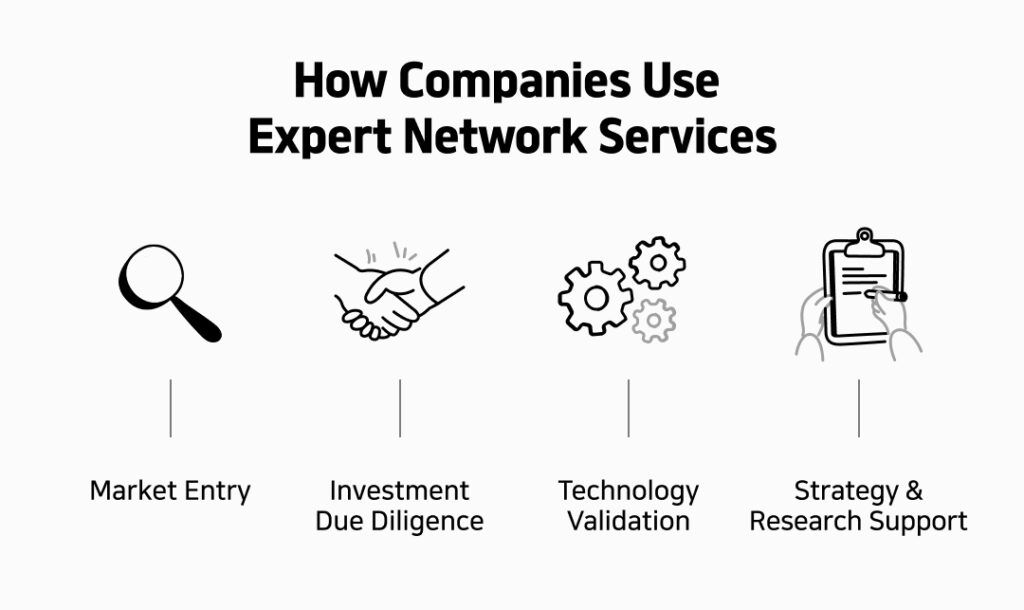
Real Commercial Due Diligence Case Using an Expert Network
The following example illustrates a commercial due diligence project conducted through the expert network service of Liahnson & Company.
A global private equity firm was evaluating the acquisition of a Taiwanese manufacturer of display and semiconductor equipment. As the announcement timeline approached, the firm needed to validate the company’s supply chain structure and market competitiveness but struggled to identify appropriate industry experts within the limited timeframe.
Through the expert network service, the client was able to:
- Match with four industry experts within two days
- Conduct phone consultations and in-person meetings within one week
- Verify the market from the perspectives of suppliers, customers, and competitors
These experts had 10 to 20 years of industry experience, allowing the client to gain key insights into supply chain structures and verify the company’s true technological competitiveness and market position.
Based on these insights, the private equity firm was able to complete its industry validation before making the final investment decision.
Why Expert Network Services Matter
Expert network services provide several advantages during corporate due diligence:
- Speed
Experts can typically be matched within 48 hours.
- Accuracy
Industry professionals with 10–20 years of experience provide reliable insights.
- Multi-angle validation
Market insights can be verified from supplier, customer, and competitor perspectives.
- Real-world insights
Experts provide information that cannot be found in public reports or datasets.
Successful investments start with high-quality information, and the most valuable insights often come from professionals who truly understand the industry.
If you are conducting commercial due diligence and need access to industry expertise, an expert network can connect you with the right professionals within 48 hours.
The Final Puzzle of Successful Investment: Corporate Due Diligence
Corporate due diligence is not simply a process for avoiding risk. It creates value by uncovering hidden investment opportunities and enabling accurate corporate valuation, ultimately improving the reliability of investment strategies.
If financial and legal due diligence evaluate a company’s fundamental strength, industry-expert-based due diligence evaluates its future competitiveness.
Are you preparing for a successful investment or M&A transaction?
Then consider validating not only financial data but also the real market position and competitiveness of the company through insights from industry experts.

Latest Posts
- Corporate Due Diligence: How to Identify Hidden Risks Behind Financial Statements
- AI in the Defense Industry: How Artificial Intelligence Is Changing Modern Warfare
- Ping An Insurance and the Future of AI Driven Insurance Transformation
- Who Is the Best ENS Company in Asia? – Why Liahnson & Company Leads the Asia Expert Network Market
- No Entry for Humans: How to Easily Understand Moltbook and Moltbot, a Bot Only Social Network Run by AI Agents