
Today, companies operate in an environment where information and data are more accessible than ever before. Market reports, statistics, and internal analyses are readily available. Yet when it comes to actual decision making, organizations often struggle to find clear answers to their most critical questions. Reports and data can describe the past, but they rarely explain how things truly work on the ground. Practical, real-world insight remains an area that even the most advanced AI cannot fully replicate.
As a result, companies are increasingly turning their attention to a different kind of information source. They are seeking the experience of people who have directly led decisions and execution within specific industries and markets. This kind of experience cannot be replaced by internal documents or public data, and it plays a crucial role in reducing uncertainty when making high-stakes decisions.
The structure that connects companies with individuals who have this relevant experience is known as an Expert Network Service, or ENS. Those who share their experience through ENS are referred to as “experts.” In this article, we explore why experts are essential to the ENS industry, how ENS projects actually work, real-world use cases, and how you can register as an expert.

What Does “Expert” Mean in ENS?
The term “expert” used in Expert Network Services differs from the common perception of the word. In ENS, an expert is not defined as an academic authority, a famous speaker, or a professional advisor. Instead, an ENS expert is someone who has firsthand experience with decision making and execution within a specific industry, organization, or market.
What companies seek from ENS experts is not opinion or advice. Rather than asking what should be done, they want a clear explanation of what actually happened and why. For this reason, expertise in ENS is defined less by theoretical knowledge and more by the depth, specificity, and realism of one’s experience.
In practice, expert interviews commonly focus on the following areas.
- Experience participating directly in real decision-making processes
- Hands-on involvement in execution and implementation
- Exposure to internal constraints and organizational realities
- Experience with failure, adjustment, and strategic pivots
- Insights gained from working within a specific industry
- Understanding of how a particular market truly operates
If you have been actively involved in your role at your current or previous company, that experience alone can qualify you as an ENS expert. Companies are looking precisely for the practical realities you encountered in your day-to-day work.

Why Do Companies Look for Experts?
Companies do not use Expert Network Services simply to gather external opinions. ENS functions as a validation tool, helping organizations bridge the gap between information and execution just before critical decisions are made. ENS experts do not design strategies on behalf of companies; instead, they provide the context needed to evaluate whether a strategy will work in the real world.
Companies typically seek ENS experts in the following situations.
1. When internal experience is limited
Most organizations only have partial exposure to certain industries or regions. A company may have deep experience in its domestic market but limited understanding of a specific overseas country. It may be strong in B2C but unfamiliar with B2B structures. In these cases, companies prefer to rely on the explanation of someone who has already operated in that environment, rather than forming assumptions from scratch.
2. When assessing execution feasibility
Many strategies appear sound on paper but encounter unexpected obstacles during execution. Internal coordination, budget constraints, regulatory interpretation, and differences in on-site capabilities often determine success or failure, yet these factors are difficult to quantify in advance. ENS experts help companies understand these execution realities, allowing them to adjust plans before costly mistakes occur.
3. When minimizing risk in high-stakes decisions
Decisions involving investment, mergers and acquisitions, or new market entry carry significant downside risk. In these situations, companies are not primarily interested in knowing what is theoretically correct. They want to understand why failures occurred in the past and under what conditions. This type of insight cannot be derived from public data or AI analysis alone. ENS experts are often the only reliable source of such experience-based risk evaluation.

Real ENS Project Case Studies
To better understand how Expert Network Services operate in practice, below are a few representative examples of how companies and experts have worked together through ENS.
Case Study 1
Digital Door Lock Market Research in China, Korea, and Southeast Asia
- Client need
The client needed to quickly understand national-level competitive dynamics, pricing structures, and value-chain margins in the digital door lock markets across China, Korea, and Southeast Asia.
- Insights gained through ENS
Executives from leading companies and experts with investment experience in the sector explained where profitability is actually determined in practice and how pricing is set in each market. Through these interviews, the client gained clarity on distribution-stage margins, country-specific competitive strategies, and the factors that define real competitiveness in each market.
Case Study 2
Validating Purchasing Decision Structures Before Entering the French IT Market
- Client need
Before expanding a proven ESN solution from Asia into the French market, the client needed a realistic understanding of competitive dynamics and local purchasing decision processes.
- Insights gained through ENS
Interviews with practitioners and former executives who had worked in the French IT market revealed the role of informal influence, how partnerships actually function, and what criteria drive adoption decisions. This allowed the client to refine its market entry strategy and adjust its sales approach accordingly.
Case Study 3
Verifying Supply Chain and Competitive Structure Prior to Acquiring a Taiwanese Manufacturer
- Client need
Ahead of acquiring a semiconductor and display equipment manufacturer, the client needed to validate supply chain realities and competitive positioning that were not visible in public disclosures.
- Insights gained through ENS
Experts with direct experience managing supply chains and customer relationships in the sector explained actual negotiation structures, cost drivers, and technical barriers to entry. These insights helped the client identify true structural strengths and finalize its acquisition decision framework.
These examples illustrate how companies, private equity funds, investment firms, consulting firms, and research organizations all rely on Expert Network Services for different strategic purposes.
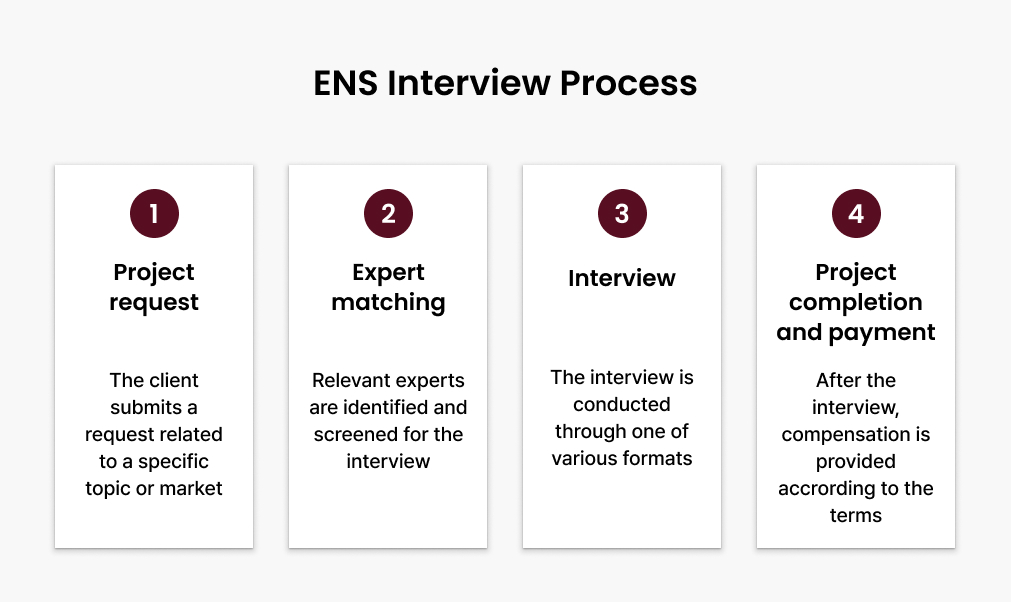
How Does an ENS Project Work?
ENS projects follow a simple and efficient process.
Step 1. Project request
The client submits a request related to a specific topic or market.
Step 2. Expert matching
Relevant experts are identified from the platform’s existing network or newly sourced for the project. A brief screening may be conducted to confirm fit, and project scope and terms are explained in advance. Once confirmed, the interview question list is shared so both sides can align expectations.
Step 3. Interview
Interviews are conducted via video, phone, written response, or in person, typically lasting 30 to 60 minutes. No materials are required; experts respond based on their own experience.
Step 4. Project completion and payment
After the interview concludes, compensation is provided according to the agreed terms. Payment is generally based on interview duration and may vary depending on interview depth and quality.

Compliance Requirements for ENS Experts
To ensure that experience-based insights are shared safely and responsibly, Expert Network Services operate under clear compliance standards. An ENS expert’s role is not to provide confidential information or advice, but to describe experiences and knowledge within a publicly shareable and appropriate scope.
Experts participating in ENS projects are protected by the following principles.
- Protection of confidential information
Experts do not share internal documents, non-public figures, contract details, or proprietary business information. Interviews are limited to openly discussable experience and general professional context.
- Conflict of interest management
If a potential conflict of interest exists due to current or past roles, participation may be restricted or clearly disclosed in advance to prevent legal or ethical risk.
- Expert control and discretion
Experts may decline to answer any question they consider sensitive or inappropriate and may stop an interview at any time. Decisions about what to share remain entirely with the expert.
- Anonymity and usage limitation
Expert identities and interview content are used only within the scope of the project and are not disclosed or cited externally without authorization.
This compliance framework exists to protect experts, not to restrict them. It enables a trusted and sustainable environment in which companies and experts can exchange knowledge responsibly.
Register Now as an ENS Expert
Participating in ENS does not mean starting a new career. It means opening an additional opportunity to share the experience you have already built in a safe and structured way. Companies are actively seeking professionals with real-world experience like yours.
Register now as an ENS expert with Liahnson & Company.
Your experience is already a valuable asset.

Latest Posts
- Global E-commerce Strategy in 2026: How Amazon, Shopify and Mercado Libre Survived C-commerce
- Market Research Company in Korea: How to Choose the Right Partner for Better Business Decisions
- CBAM 2026 Consulting Guide: What Global Companies Must Know and How to Respond
- The Role of Research Agencies in Modern Business: From Data Collection to Strategic Insight
- AI Smart Glasses 2026: Market Trends, Key Players, and Future Outlook
Leave a Reply
You must be logged in to post a comment.