Happy New Year and welcome to 2026!
As 2026 begins, many global experts agree that this year represents a major inflection point in the evolution of technology. Artificial intelligence is no longer just a tool. It is rapidly becoming a collaborator and, increasingly, a physical executor in the real world. This shift is fundamentally reshaping not only business environments but also everyday life.
After witnessing the rapid rise of generative AI over the past few years, 2026 marks the year when AI moves from experimentation to real-world deployment. What once felt like trial and error has now transitioned into a phase of tangible value creation. At the same time, however, this acceleration has introduced unresolved challenges, including content authenticity, AI accountability, disclosure of AI-generated content, and the growing energy demands of AI systems.
In this article, we introduce the Top 10 technology trends defining the first half of 2026, as identified by global consulting firms and technology leaders. These are not distant predictions. They are trends already taking shape across industries worldwide.
So what 2026 technology trends should business leaders be paying close attention to?

1. Physical AI and Humanoid Robots
Physical AI refers to artificial intelligence systems that integrate computer vision, natural language processing, and motor control to perform tasks in the physical world. Technologies such as ChatGPT, Gemini, and Claude are now extending beyond screens and into real-world environments.
Humanoid robots, once limited to research labs and exhibitions, are expected to enter logistics centers, manufacturing sites, healthcare facilities, and even home services by 2026. As physical AI converges with multi-agent systems, robots are evolving from machines into functional team members.
For example, one robot may conduct inventory checks, another agent system may optimize delivery routes, and a third robot may physically move goods. What once seemed futuristic is now operational reality. Deloitte’s Tech Trends 2026 and announcements at CES 2026 from companies such as LG and Hyundai highlight this commercialization shift.
2. Multi-Agent Systems (MAS) and Agentic AI
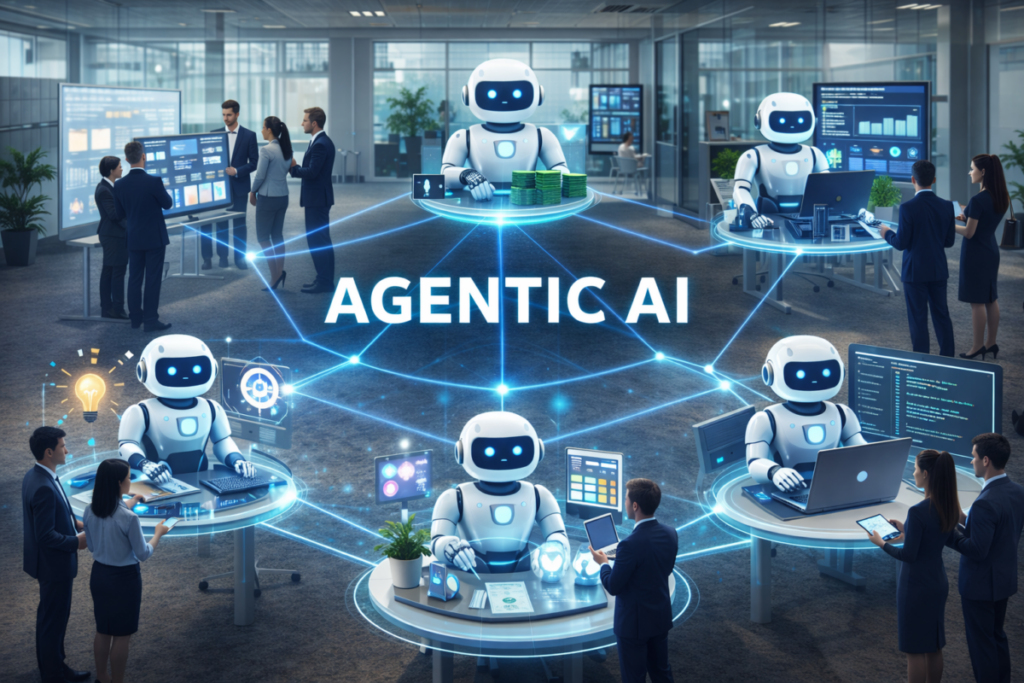
Among the most frequently cited 2026 technology trends is the rise of multi-agent systems. Instead of relying on a single large AI model, MAS consists of multiple specialized AI agents collaborating to complete complex tasks.
Marketing agents, finance agents, design agents, and development agents communicate and coordinate autonomously. Humans define high-level objectives and constraints, while agent networks handle execution, validation, and optimization.
At the enterprise level, agentic AI is evolving into an operating-system-like layer that orchestrates workflows across departments, enabling real-time decision support and autonomous collaboration. Global AI trend reports consistently identify MAS as a cornerstone of enterprise AI strategies in 2026.
3. Zero-Click Commerce and Agentic Commerce
The traditional e-commerce funnel—search, compare, add to cart, and checkout—is rapidly disappearing. One of the most disruptive 2026 technology trends is zero-click commerce.
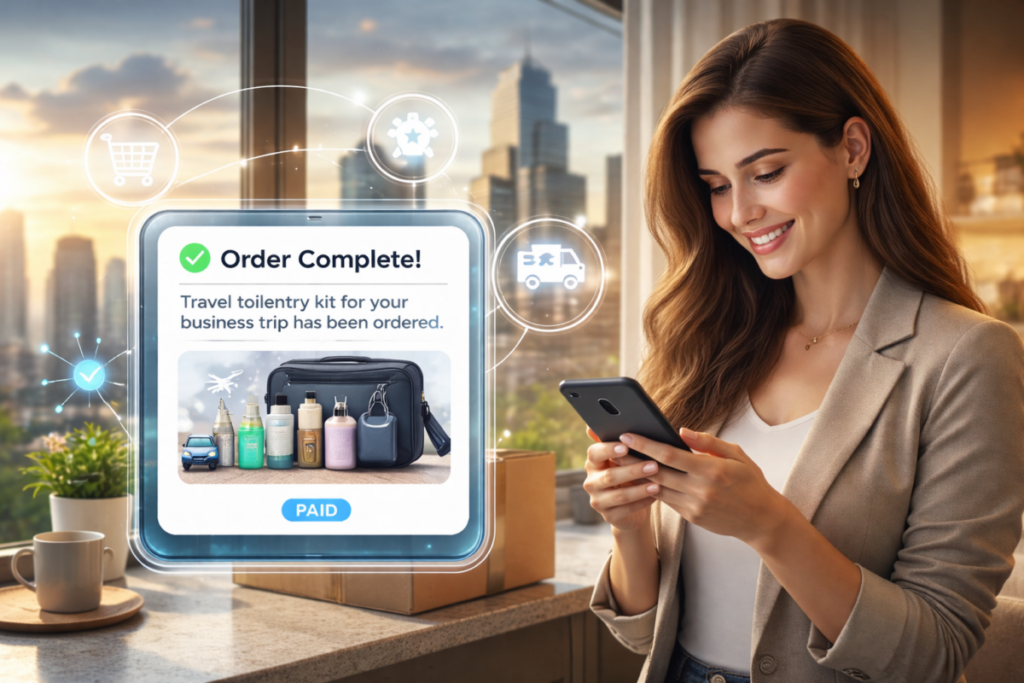
Users can now place orders through natural language requests, with AI agents handling product selection, payment, and delivery automatically. For example, a user can say, “Order a travel toiletry kit for my business trip next week,” and the AI completes the purchase based on preferences, budget, and schedule.
As a result, brands are no longer competing for consumer clicks. They are competing to be selected by AI agents. Product data structure, API integration, review credibility, and trust signals are becoming critical marketing assets. Research firms such as Forrester identify zero-click commerce as a defining force in the retail industry for 2026.

4. Domain-Specific Language Models (DSLMs)
Despite the power of general-purpose AI models, their limitations become clear in highly specialized fields such as healthcare, law, finance, and semiconductor design.
Domain-specific language models are trained on industry-specific data and understand specialized terminology, regulations, and workflows. Gartner predicts that a significant portion of enterprise generative AI models will shift toward DSLMs by 2028.
When combined with multi-agent systems, DSLMs unlock even greater value. Legal agents rely on legal-specific models, while financial agents use finance-focused models, collaborating seamlessly within the same ecosystem.
For organizations seeking insights beyond publicly available data, expert network services provide direct access to professionals with real-world, domain-level expertise.

5. Digital Provenance and Content Authenticity
As AI-generated content becomes dominant, verifying authenticity has become a critical issue. Digital provenance addresses this challenge by ensuring content traceability and integrity.
Standards such as C2PA allow encrypted metadata to record a content’s creation history, including whether AI was involved, how it was edited, and when changes occurred. Watermarking and blockchain technologies preserve this information permanently.
By 2026, content provenance will no longer be optional. Search engines and social platforms are already prioritizing verified content, and brands are adopting provenance standards as best practice. Analysts increasingly describe digital provenance as the quality control system of the digital economy.

6. Predictive Cybersecurity
Traditional cybersecurity focuses on detection and response after an attack occurs. In 2026, the standard is shifting toward predictive cybersecurity.
Using AI and machine learning, organizations can create digital twins of their IT environments and simulate thousands of attack scenarios to identify vulnerabilities before exploitation occurs. This shift is driven by the reality that attackers are also using AI to automate reconnaissance, phishing, and evasion tactics.
Security research firms, including Gartner, predict that predictive security will become a baseline expectation for enterprises starting in 2026, not a competitive advantage but a survival requirement.

7. AI Infrastructure Technology and Energy Leadership
Few people realize that generating a single AI response can consume more than ten times the energy of a traditional search query. As AI demand accelerates, data center energy consumption has become a national-level concern.
One of the most critical 2026 technology trends is the intersection of AI infrastructure and energy. Industry leaders have emphasized that AI scalability is increasingly constrained by power availability rather than semiconductor supply.
Technologies such as small modular reactors, advanced cooling systems, next-generation batteries, and large-scale energy storage are expected to shape the AI infrastructure landscape. Companies and countries that secure energy leadership will gain a decisive advantage in the AI economy.

8. Human-in-the-Loop and Responsible AI Governance
As AI automates more tasks, human judgment becomes more valuable. Human-in-the-loop governance ensures that final decisions, especially in high-risk or ethical scenarios, remain under human responsibility.
Examples include financial approvals, medical diagnoses, and hiring decisions where AI provides recommendations, but humans retain accountability. This approach enhances transparency, explainability, and trust.
Labor market data reflects this shift. While demand for junior and routine roles declines, demand for highly experienced professionals continues to grow. Responsible AI governance reinforces the strategic value of senior expertise.

9. Hyper-Personalization and Emotional Intelligence Technology
One of the most notable 2026 technology trends is the rise of emotion-aware systems. Technology is no longer optimized solely for speed and efficiency, but for emotional well-being and psychological satisfaction.
Wearables, facial analysis, and voice recognition enable systems to adapt lighting, music, content, and recommendations based on emotional state. The value proposition of technology is shifting from performance to emotional resilience and energy management.
Lifestyle trend reports consistently highlight this transition toward emotion-centered digital experiences.

10. New Living and Relationship Models
The rise of single-person households is evolving into a broader shift toward flexible connection models. People increasingly live independently while forming deep, selective connections when needed.
Remote work, digital communities, and smart living technologies enable meaningful connection without physical cohabitation. AI assistants, smart home systems, and service robots support secure and comfortable independent living.
Global lifestyle analysts describe this trend as “living small while connecting deeply,” identifying it as a defining social shift of 2026.
Conclusion
These ten 2026 technology trends are not isolated. Physical AI converges with multi-agent systems, zero-click commerce integrates with hyper-personalization, and digital provenance underpins responsible AI governance. All of these trends are supported by AI infrastructure and energy innovation, reshaping how we live and work.
Organizations that proactively align their strategies with these trends will unlock new opportunities. Those that delay will face growing risks.
2026 is the year AI transitions from innovation to infrastructure. Change is already underway, and opportunity favors those who are prepared.If you would like to gain practical insights directly from industry leaders who are already navigating these trends, Liahnson & Company can connect you with the right experts to support your business and strategic initiatives in 2026.

Sources
https://newatlas.com/technology/elon-musk-ai
https://megaeconomy.co.kr/news/newsview.php?ncode=1065585921042557
https://www.chosun.com/english/industry-en/2026/01/01/5JQA2ZK72FGGRCEC4CNE3C2IA4
https://tech.hancom.com/2026-ai-trends-agentic-ai-beyond-tools/
https://tech.hancom.com/2026-ai-trends-agentic-ai-beyond-tools/
skax.co.kr/insight/trend/3570/
https://commercetools.com/blog/trends-that-define-retail-success
https://viitorcloud.com/blog/top-8-ai-trends-in-2026/
https://sigmatechnology.com/articles/tech-trends-in-2026-signals-not-noise/
https://www.eccu.edu/blog/cybersecurity-trends-2026/
https://sigmatechnology.com/articles/tech-trends-in-2026-signals-not-noise/
https://www.weraddicted.com/top-trends-in-lifestyle-entertainment-for-2026/
https://thebalancededitmag.com/2026-lifestyle-trends-how-well-live-work-and-rest-differently/

Leave a Reply
You must be logged in to post a comment.